The Mind Behind the Footprints: Why Intelligence Changes Everything
Wildfoot Hypothesis Series Synthesis Volume (Connecting Theories 13–18)
Posted on December 15, 2025 by Wildfoot Explores
What follows is not proof, but a pattern-based attempt to explain why several competing theories stop contradicting each other once intelligence is treated as the foundation instead of the exception. Images are used for visual context and understanding, not as proof.
- People Also Ask
- What is the core Wildfoot Hypothesis about Bigfoot?
- When the Observer Becomes the Observed
- What This Blog Is (And Isn’t)
- The False Divide Between “Biology” and “Weird”
- How to Read the Theories That Follow
- CATEGORY 1: Misunderstood Biology
- CATEGORY 2: Cultural Interpretation
- CATEGORY 3: Strategic Intelligence
- The Pattern That Can’t Be Ignored
- What Comes Next
- Head’s up Disclosure
- Want to explore more check out the new Audio-Books

People Also Ask
The Mind Behind the Footprints
What is the core Wildfoot Hypothesis about Bigfoot?
At its core, the Wildfoot Hypothesis looks at one simple shift. Instead of treating intelligence as an exception, it treats intelligence as the foundation. Once you do that, a lot of competing Bigfoot theories stop fighting each other. The idea isn’t that Bigfoot is supernatural. It’s that it’s biological, highly intelligent, and strategically adapted to the wilderness in ways humans don’t fully understand.
How does the blog argue that Bigfoot is intelligent?
The argument comes from patterns, not one-off stories. Across regions, decades, and cultures, witnesses describe the same behaviors. Observation before engagement. Controlled distance. Strategic withdrawal. Timing instead of impulse. Those aren’t random animal reactions. Those are consistent, tactical decisions that point to intelligence, not instinct alone.
If Bigfoot is intelligent, why do people describe “supernatural” abilities?
The blog reframes most of those experiences as misunderstood biology. Things like sudden dread, paralysis, or nausea align with known effects of infrasound in animals. What people call “cloaking” often comes down to positional mastery, understanding human blind spots, terrain, and lighting. When something is faster, quieter, and more aware than we expect, it feels supernatural, even when it isn’t.
What is the “false divide between biology and weird” in Bigfoot research?
Bigfoot research often splits into two camps. One side insists it must be a dumb ape. The other insists it must be interdimensional or paranormal. The blog argues that this divide is artificial. A biological being with advanced intelligence and strategic behavior would naturally appear strange to us. The “weird” doesn’t disappear. It just gets explained.
Does the Wildfoot Hypothesis suggest Bigfoot is a threat to humans?
No. If anything, the opposite. Many encounters look like ambushes with restraint. People are watched, pressured, or redirected, but not attacked. That points to rules, teaching, and culture. It suggests a species capable of control, not chaos. Observation instead of aggression. Awareness instead of impulse.
When the Observer Becomes the Observed
Crew, there’s a moment every serious researcher hits.
It’s not when they hear their first story.
It’s not when they see their first track.
It’s not even when they experience something strange in the woods.
It’s the moment they realize something uncomfortable.
These encounters aren’t describing an animal that got surprised by humans.
They’re describing a being that planned the encounter.
Hunters tell me, “It waited until I was alone.”
Campers say, “It circled us for hours before showing itself.”
Truckers say, “It stepped out exactly where I couldn’t avoid seeing it.”
If this was instinct, the behavior would be random.
If this was coincidence, the patterns would change by region.
They don’t.
From British Columbia to Pennsylvania, from Ontario to Texas, the same behavioral signature shows up again and again:
- Evaluation before approach
- Timing over impulse
- Observation without confrontation
- Controlled distance
- Strategic withdrawal once attention is drawn
That isn’t wildlife behavior.
That’s tactical intelligence.
And once you see it, you can’t unsee it.
What This Blog Is (And Isn’t)
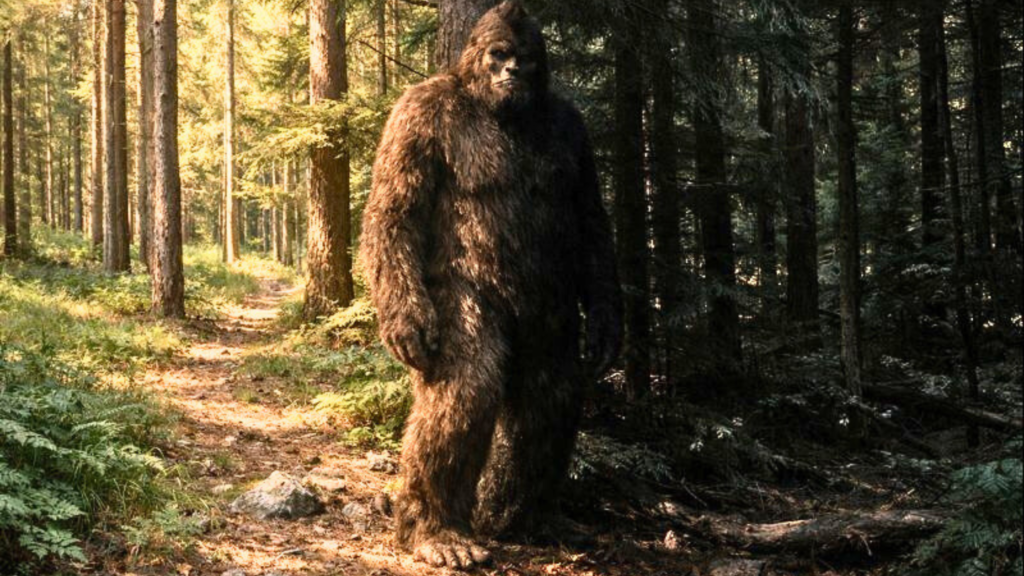
This blog does not introduce new theories.
It connects the ones we’ve already been circling:
- Government interest
- Underground refuge
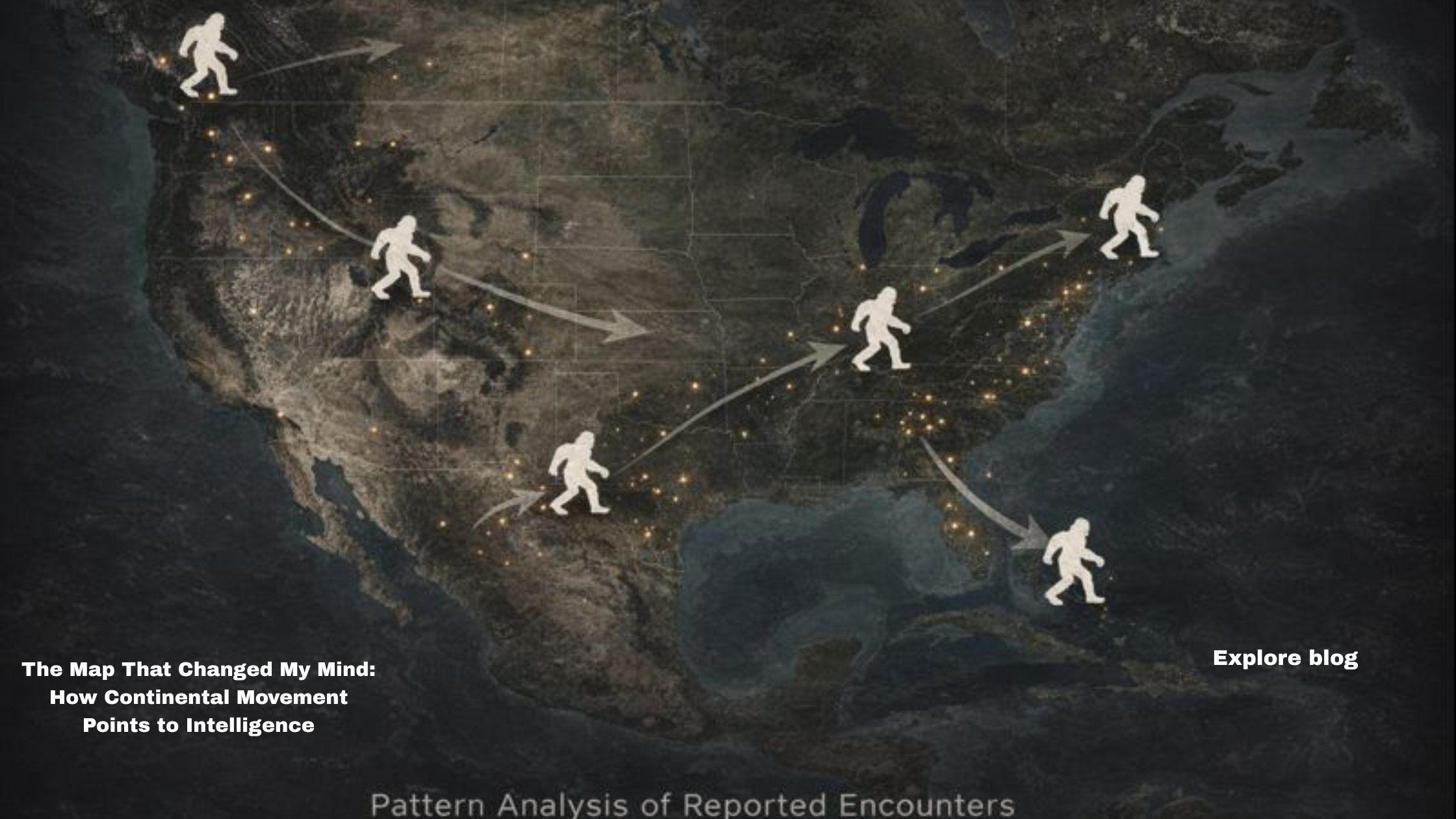
- Migratory corridors
- Ultra-stealth behavior
- Bloodline divergence
- Environmental mastery
On the surface, these ideas look unrelated.
But when you strip away labels and focus on behavior, one constant remains: intelligence.
Not human intelligence.
Wilderness intelligence.
The False Divide Between “Biology” and “Weird”
This is where most Bigfoot research falls apart.
One side says, “It’s supernatural. Interdimensional. Spiritual.”
The other says, “It’s just a dumb ape people misidentify.”
Both miss the middle ground.
What if Bigfoot is biological… but smarter than we’re comfortable admitting?
That’s not supernatural.
That’s just disruptive.
Because if a 900-pound biped can track you without being tracked, plan encounters, communicate across miles, and vanish in terrain where visibility should be clear, then we are not the apex intelligence in the woods.
They are.
And that changes everything.
How to Read the Theories That Follow
The theories below are not presented as competing explanations.
They are lenses people have used to describe the same underlying behavior.
Grouped correctly, they stop competing and start aligning.
None require magic.
All require accepting something humans resist:
There is something out there that thinks.
CATEGORY 1: Misunderstood Biology
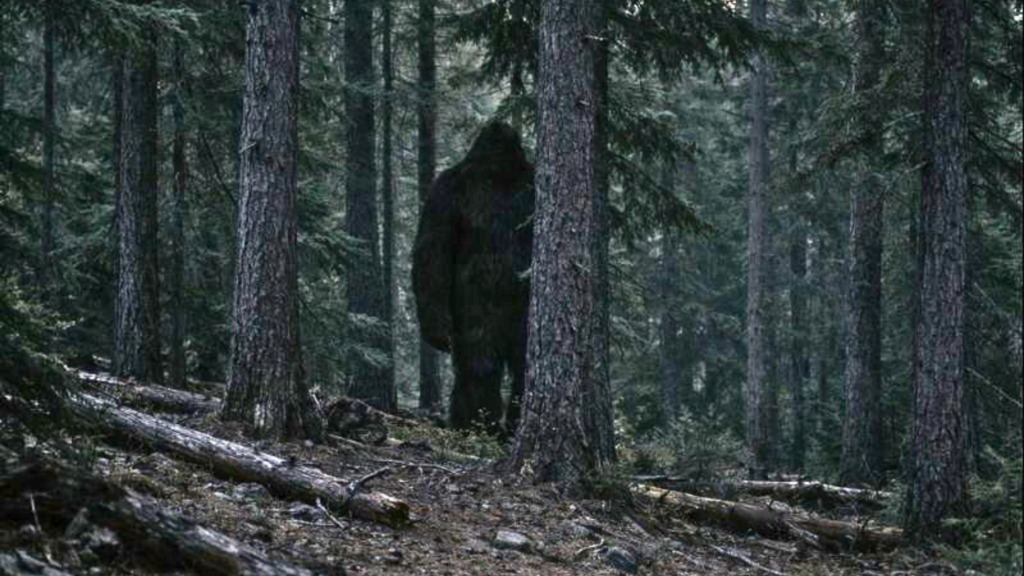
The “Supernatural” Abilities That Aren’t
Theory 1: Infrasound and Biological Intimidation
Witnesses describe sudden dread, chest pressure, and paralysis.
Infrasound is documented in tigers, elephants, and whales. It causes fear, nausea, and disorientation. A species combining primate vocal control with ancient hominin lung capacity could weaponize sound.
Not energy.
Acoustic dominance.
Theory 2: Cloaking and Visual Blind Spots
This isn’t invisibility. It’s positional mastery.
Human vision has gaps. A species that understands how we see can place itself where we don’t look, move when our eyes fail, and remain unseen in plain sight.
Not magic.
Mastery.
Theory 3: Electromagnetic Sensitivity
Magnetoreception exists in birds, sharks, and insects.
A species adapted to cave systems, fault lines, and underground water would rely on electromagnetic awareness. Our devices are loud in that spectrum.
This explains camera failures and battery drain without invoking interference.
Theory 4: The Ultra-Stealth Predator
These encounters aren’t ambushes for attack.
They are ambushes with restraint.
Restraint requires rules.
Rules require teaching.
Teaching requires culture.
CATEGORY 2: Cultural Interpretation
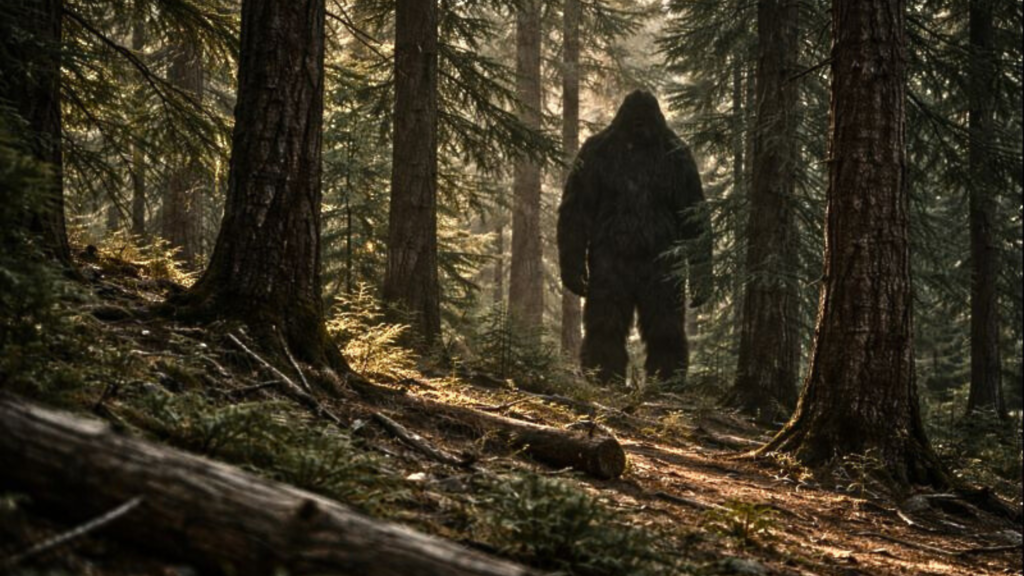
Same Intelligence, Different Language
Theory 5: Interdimensional Being
Sudden appearances aren’t dimensional jumps. They are perception failures combined with speed, terrain knowledge, and preparation.
Theory 6: Forest Guardian
Indigenous “Guardian” stories describe territorial authority, not fantasy. Respect the Alpha.
Theory 7: Shape-Shifter
Bigfoot doesn’t change shape. The brain changes explanations when expectations collapse.
Theory 8: Soul-Walker
That overwhelming “presence” is the body detecting threat before the mind understands it. Ancient survival systems firing as intended.
Sacred doesn’t mean supernatural.
It means deeply recognized.
CATEGORY 3: Strategic Intelligence
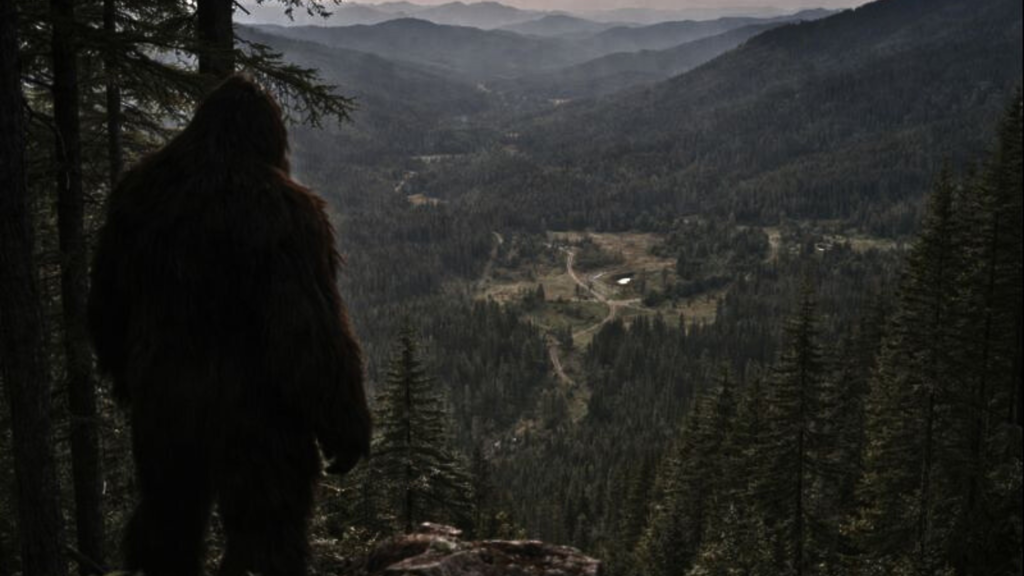
Where the “Dumb Animal” Theory Dies
Theory 9: Government Interest
Governments study intelligence. Bigfoot behavior mirrors counter-surveillance and terrain exploitation.
Theory 10: Underground Species
Over 90% of cave systems are unmapped. Deep refuge explains absence without invoking extinction.
Theory 11: Migratory Logistics
Animals migrate by season. Intelligence moves by strategy.
Theory 12: Bloodline Divergence
Humans are hybrids. Hybridization didn’t stop with us.
Theory 13: Environmental Mastery
Bears adapt. Wolves adapt. Humans adapt.
Bigfoot adapts better.
Theory 14: Family Unit Intelligence
Protectors. Observers. Young. Teaching.
That’s not a pack.
That’s a culture.
The Pattern That Can’t Be Ignored
Four theories explain “supernatural” traits biologically.
Four show cultural translation of intelligence.
Six demonstrate strategic decision-making.
Zero require magic.
Fourteen perspectives point to one conclusion:
Bigfoot isn’t lucky.
Bigfoot is smart.
What Comes Next
This synthesis focused on intelligence as the missing link between biology, movement, and behavior.
The final volume will focus on perception why some encounters feel impossible, and how human sensory limits shape the strangest reports.
Not to weaken the framework.
To complete it.

Head’s up Disclosure
As an Amazon Associate I earn from qualifying purchases. Some of the links in the Wildfoot Book Library are affiliate links to Amazon. This means I may earn a small commission if you decide to make a purchase, at no extra cost to you. All links are here to explore freely, with no obligation.
The library features books I’ve personally written, connected to the worlds of Bigfoot, hidden truths, survival, and the paranormal. Whether you’re diving into my latest release or exploring trusted gear, every link is designed to support your curiosity and deeper exploration.
I only share books and products I genuinely believe in or have created myself. You’ll also find some items connected to my other platforms, including Paranormal Curiosities Realm.
Thanks for visiting and supporting independent research and storytelling.
Shawn Thomas
Amazon Author & Creator
Founder of Wildfoot Explores and Wildfoot Explores Apparel shop
Want to explore more check out the new Audio-Books
Crew, I want to hear from you.
Does this intelligence pattern make sense to you? Or do you think I’m connecting dots that aren’t there?
Drop your thoughts below. We break this down together.
Stay curious. 🌲👣