
Wildfoot Hypothesis Series Part 5
After talking with hundreds of witnesses over the years, one thing has become crystal clear to me:
People don’t report Bigfoot for fun. They don’t do it for attention. They don’t do it to get famous.
Most of them look like they’re confessing something heavy something they’ve carried for years.
And the strangest part? Their descriptions match.
- Different people.
- Different backgrounds.
- Different beliefs.
- Different continents.
- Different generations.
- Same creature.
You can dismiss one sighting. You can argue a blurry video. But you cannot dismiss thousands of strangers, from completely different parts of the world, describing the same animal in stunning detail.
This is where eyewitness testimony becomes one of the strongest pillars in the Wildfoot Hypothesis.
Not because the stories are dramatic… but because the details never drift.
Patterns in nature don’t drift. Myths drift. Stories drift. Legends drift. Species stay consistent.
Let’s break it open.
- Why Eyewitness Evidence Matters More Than People Realize
- The Global Consistency The Detail That Changes Everything
- The Consistency Signature, What Witnesses Describe
- Emotional Reactions: The Witness Pattern Almost No One Talks About
- Witness Credibility: The Part Skeptics Refuse to Discuss
- Worldwide Witness Data: The Global Pattern
- People Also Asked
- Christmas Note
- Next in the Series
Why Eyewitness Evidence Matters More Than People Realize

Skeptics love to say eyewitness testimony is “weak.”
But here’s the truth nobody talks about: Wildlife biology is built on eyewitness encounters.
Most species were discovered because of:
- Hunters
- Trappers
- Indigenous elders
- Fishermen
- Explorers
- Forest workers
- Locals
Eyewitness reports are part of the foundation of zoology. And when thousands of reports match not in generalities, but in fine detail, you get what wildlife biologists call a:
Behavioral Signature
A real species leaves repeating patterns behind it. And Bigfoot does exactly that. (Removed the second repetition)
The Global Consistency The Detail That Changes Everything

This is one of the most important points in all of Bigfoot research:
Thousands of independent eyewitnesses around the world describe the same being.
- No shared culture.
- No shared folklore.
- No internet.
- No communication.
- No cross-population influence.
Yet the details match almost perfectly. Researchers actually have names for this:
1. Cross-Cultural Validation
Cultures separated by oceans and centuries describe:
- 7–10 ft tall
- Massive upper body
- Long arms
- Upright stride
- Deep-set eyes
- Heavy brow
- Avoidance behavior
- Tree knocks and whistles
- Tracking humans from cover
This kind of consistency across civilizations is biological, not mythological.
2. Species-Level Consistency
Zoologists argue: “If global descriptions are identical, you’re looking at a single biological species.”
- Different continents.
- Same blueprint.
Humans do this. Bears do this. Wolves do this. And Bigfoot-type beings do this too.
3. The Global Hominoid Theory
This theory states: Sasquatch, Yeti, Yowie, Alma, Skunk Ape = regional populations of one unknown global hominoid species.
- Local names.
- Local environments.
- Same creature.
This theory is used by:
- Grover Krantz
- John Green
- Bernard Heuvelmans
- Modern primate researchers
- Cryptozoological databases
Because the data is overwhelming.
The Consistency Signature, What Witnesses Describe

Here’s what thousands of eyewitnesses repeat worldwide:
- Height: 7–10 feet. Never tiny. Never giant like myths. Always just outside human range.
- Build: Massive, muscular, thick. “Like a refrigerator turned sideways” is the #1 phrase I hear.
- Shoulders: Extremely wide. Much wider than a human body.
- Arms: Mid-thigh to knee length. A pure primate trait humans don’t have this.
- Gait: Smooth, fast, and silent. Witnesses all say: “It shouldn’t move that fast.”
- Face: Human-like, but heavier. Deep-set eyes, heavy brow, flat nose, wide jaw, Expression of intelligence.
- Color: Dark brown, black, auburn, reddish. Species-level consistency.
- Odor: Musky, rotten, swampy, sulfuric. Apex predators often have a scent signature.
And the micro-details repeat across continents:
- Hands (not paws)
- Bare skin around eyes
- Cone-shaped or rounded head
- No visible neck
- Long strides
- Heavy footfalls
Again: That’s not myth drifting. That’s biology repeating.

Behavioral Patterns: The Real Give-Away
If you want to know if an animal is real, ignore the videos and study the behavior. Behavior tells the truth.
Around the world, people report identical behaviors:
- Tree knocks: Primates use sound for distance communication.
- Whistles: Short-range signals.
- Rock throws: Warning behavior, not violence. Exactly what gorillas do.
- Bluff charges: Dominance display another ape behavior.
- Tracking from the shadows: “Something was pacing me” repeated endlessly.
- Staying at the treeline: Never exposing themselves unless crossing fast.
- Nocturnal dominance: Most sightings from dusk to dawn.
- Vocalizations no known animal makes: Screams, roars, whoops, low-frequency booms.
- Curiosity mixed with caution: They approach… then vanish.
This behavior repeats in:
- Alaska
- BC
- Washington
- Idaho
- Maine
- Ontario
- Appalachia
- Australia
- Russia
- China
- Nepal
That’s not random. That’s species-level behavior.
Emotional Reactions: The Witness Pattern Almost No One Talks About
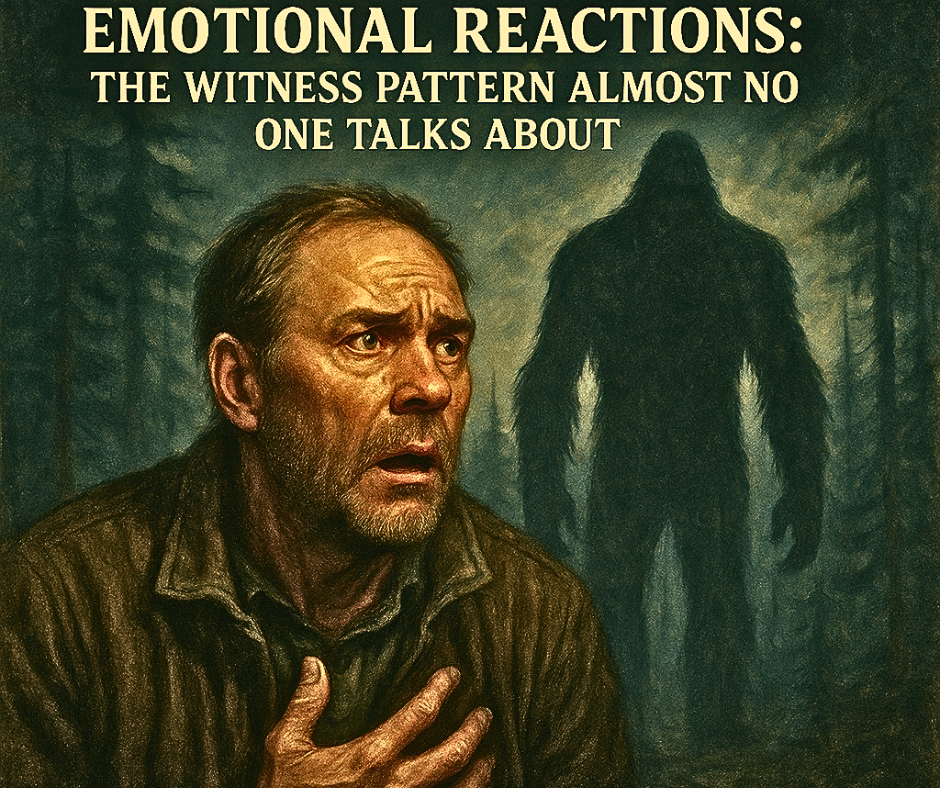
This part rarely gets talked about: Witnesses describe a feeling.
Not terror. Not shock.
Presence. An awareness. A pressure. A sense of being watched by something intelligent. Something that knows it has the advantage.
The forest goes silent. The air feels heavy. Instinct kicks in.
Animals don’t cause this. Apex hominins do.
This emotional pattern repeats everywhere.
Witness Credibility: The Part Skeptics Refuse to Discuss
Over 80% of Bigfoot sightings come from hunters, anglers, hikers, military personnel, police officers, logging crews, and Indigenous groups.
These aren’t people who confuse bears for giant primates. These are trained observers.
They know tracks. They know animal behavior. They know the land.
And NONE of them report: “I think I saw a bear walking weird.”
Instead they say: “I saw something I cannot explain.”
And they describe the same creature thousands of others describe.
That’s not hysteria. That’s field consistency.
Worldwide Witness Data: The Global Pattern
Bigfoot in North America. Yeti in the Himalayas. Yowie in Australia. Alma in Russia.
Different continents. Same creature.
This is cross-cultural validation, one of the strongest pieces of natural evidence in science.
People Also Asked
Are Bigfoot sightings credible?
Yes. Most come from experienced outdoorsmen with nothing to gain. Reports are consistent in behavior, appearance, and movement, matching real primate traits.
Why do so many people describe the same creature?
Because Bigfoot has consistent biology — long arms, heavy build, wide shoulders, and a distinctive gait making sightings remarkably similar across regions.
Is Bigfoot always seen in the same places?
Sightings cluster in forested, mountainous, and remote regions with abundant food, water, and cover typical habitat for a large primate.
Do Bigfoot encounters follow patterns?
Yes. Tree knocks, rock throws, pacing behavior, shadow-tracking, and twilight movement appear in thousands of reports worldwide.

Affiliate Disclosure
As an Amazon Associate, I earn from qualifying purchases. Wildfoot Explores also participates in additional affiliate programs. This means that some links throughout this blog may earn me a small commission at no extra cost to you. These commissions help support the research, time, and resources that go into building Wildfoot and sharing Bigfoot content every week. I only recommend products and books that I genuinely believe add value to my readers.
Christmas Note
Winter always brings out the truth in the wilderness. Snow holds tracks. Silence carries sound farther. And the old stories hit deeper when the nights get long.

If this eyewitness breakdown fires you up the way it does me, the Wildfoot books dive even deeper into these patterns. They make great winter reads or Christmas gifts for people who love the unknown.
Next in the Series
Blog 6 Environmental Logic Why Bigfoot Stays Hidden



Drop a comment would love to hear your thoughts ?