
The Bigfoot world isn’t just a tangled mess of legends and theories; it’s a layered narrative filled with lore, and I’ve spent years pulling at the threads that make up that patchwork. Believers are camped on opposite ends of the spectrum. Some see Bigfoot as purely flesh and blood. Others see something far more otherworldly.
It’s no secret that Bigfoot, or Sasquatch if you will, has captured imaginations across generations. On one side, you’ve got skeptics grounded in science. On the other, people convinced there’s a deeper, mystical layer. For years, these groups have defended their camps hard.
But what if there’s more common ground than we think?
Bigfoot Hybrid Framework
Welcome to what I call the Hybrid Framework.
Not a compromise. Not a fantasy blend.
But a way of examining how the tangible and the mysterious might overlap in ways neither camp fully accounts for alone.
The consistency in witness descriptions suggests a real biological entity. But the unusual capabilities reported suggest something more than a simple primate.
Too often, people feel pressured to pick a side. But when you look at centuries of sightings, the data doesn’t feel random. It feels structured. Like a roadmap hiding in plain sight.
At the core of this belief is open-minded exploration. The Hybrid Framework doesn’t reject skepticism. It invites it to stay in the room. This isn’t about choosing camps. It’s about recognizing that a unified approach explains more than either extreme alone.

People Also Ask
- What is the Bigfoot Hybrid Theory?
The Hybrid Theory suggests that Sasquatch is a biological, flesh-and-blood entity that possesses advanced or “high-strangeness” capabilities, such as interacting with infrasound or electromagnetism, which explains why they remain so elusive.
- Why have we never found a Bigfoot body?
Proponents of the Hybrid Theory suggest a mix of factors: highly intelligent avoidance behaviors, strategic movement in remote geographical clusters (like cave systems), and potentially the ability to perceive and avoid human technology like trail cams.
- Is Bigfoot human or ape?
Witness descriptions often report a “mito-nuclear discordance” features that are not fully ape nor fully human. The Hybrid Theory explores the possibility of an unidentified ancestral bloodline that bridges this gap.
- What are “Shadow Beings” in Bigfoot research?
This refers to sightings where the creature appears to “vanish” or blend into the environment. Rather than magic, this may be a biological “operating system” involving perceptual thresholds that humans don’t fully understand yet.
The Biological Evidence: Body & Survival
Ever dig into a mystery loaded with physical clues but no easy answers?
That’s Bigfoot.
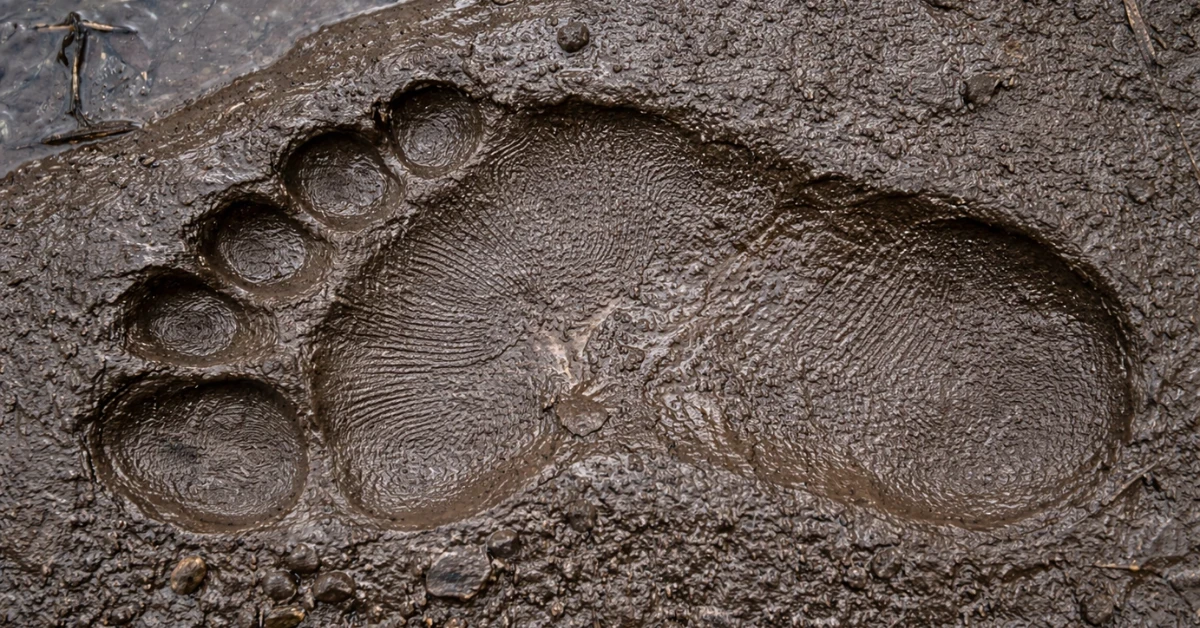
Seventeen-inch tracks pressed deep into mud.
Ground-shaking encounters.
Tree structures that require force, not folklore.
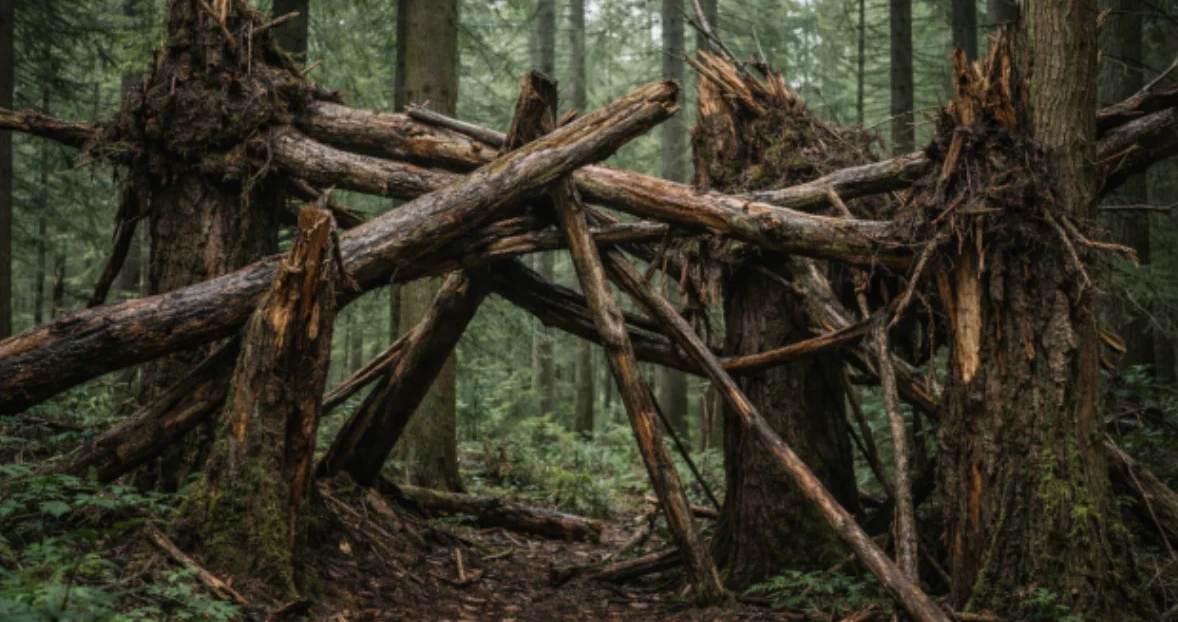
These are physical traces. Broken timber. Territorial markers. Signs of presence, not imagination.
When you start gathering those pieces, you see a survival story unfold. Territory control. Resource management. Longevity across generations. This isn’t chaos. It’s adaptation.
That’s why I still respect the flesh-and-blood model. Underneath all the lore, there is a body moving through space.
In The Big Questions of Bigfoot: How Does Bigfoot Endure?, I break down those survival mechanics food sourcing, movement corridors, behavioral restraint. If something has endured this long, it’s not luck. It’s strategy.
Survival on this scale doesn’t exist in fairy tales.
It exists in systems.
High-Strangeness and Capabilities: Beyond the Physical
Now we step into the part that stretches comfort zones.
If Bigfoot is purely biological, why no confirmed bodies?
How do they vanish in open terrain?
Why the sudden silence before sightings?
Why the consistent reports of infrasound effects and environmental distortion?
Across continents, similar patterns appear in reports. That may not be random storytelling. It may suggest an underlying structure worth examining.
Instead of dismissing these accounts, the Hybrid Framework allows us to ask a better question:
What if the biological model is only part of the equation?
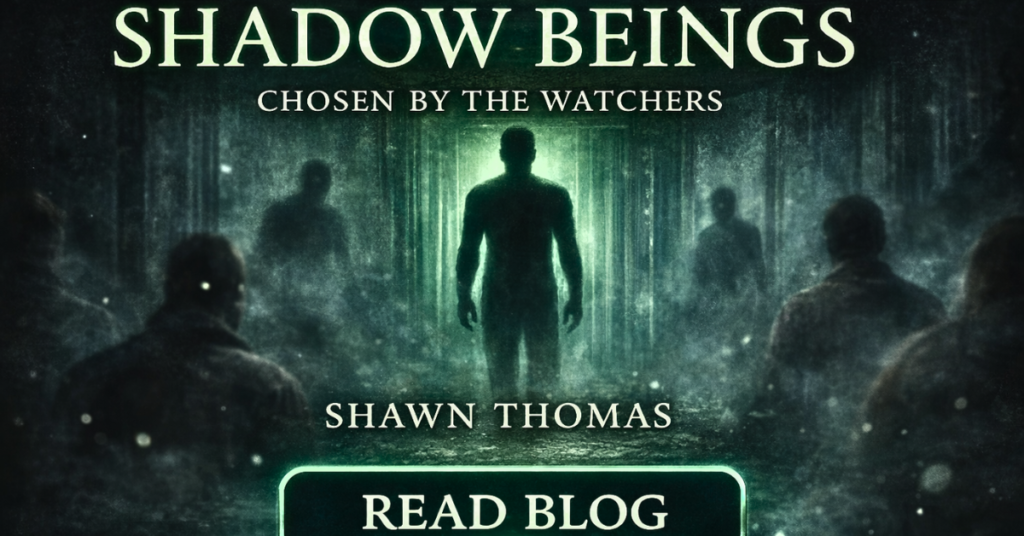
In The Architecture of the Unknown, I map these repeating behavioral patterns. And in Shadow Beings: Chosen by the Watchers, I explore the overlap between physical presence and energy phenomena.
Not to replace biology.
To expand the lens.
The Hybrid model explores the possibility of a biological being interacting with environmental forces we do not yet fully understand electromagnetism, infrasound, perceptual thresholds.
Body plus operating system.
That framework attempts to account for more of the reported data than either camp standing alone.
Ancestry and the Bloodline Puzzle
Facial descriptions reported by witnesses often land in an uncomfortable middle ground.
Not fully ape. Not fully human.
The mystery may not live only in genetics it may be visible in anatomy.
One recurring detail in large tracks is the mid-tarsal flexion. A pressure ridge appearing across the center of the footprint rather than a rigid arch. In primates this functions as a flexible foot used for terrain adaptation rather than efficient long-distance walking.
That matters because the track behavior does not match modern human biomechanics.
So we are left with a strange possibility:
A being showing human-adjacent characteristics…
while moving through the environment like a powerful non-human primate.
Some researchers have discussed the possibility of unusual maternal and paternal lineage signals in reported samples. In broader evolutionary biology, conflicting mitochondrial and nuclear ancestry is referred to as mito-nuclear discordance a known phenomenon when maternal and paternal lineages point to different evolutionary paths.
Now step outside the lab and into culture.
Wild men.
Forest people.
The watchers in the trees.
The same description appears across continents separated by language, time, and belief systems.
Maybe the argument has never been biology versus folklore.
Maybe both are describing the same pattern
from different directions.
Something that may sit between categories.
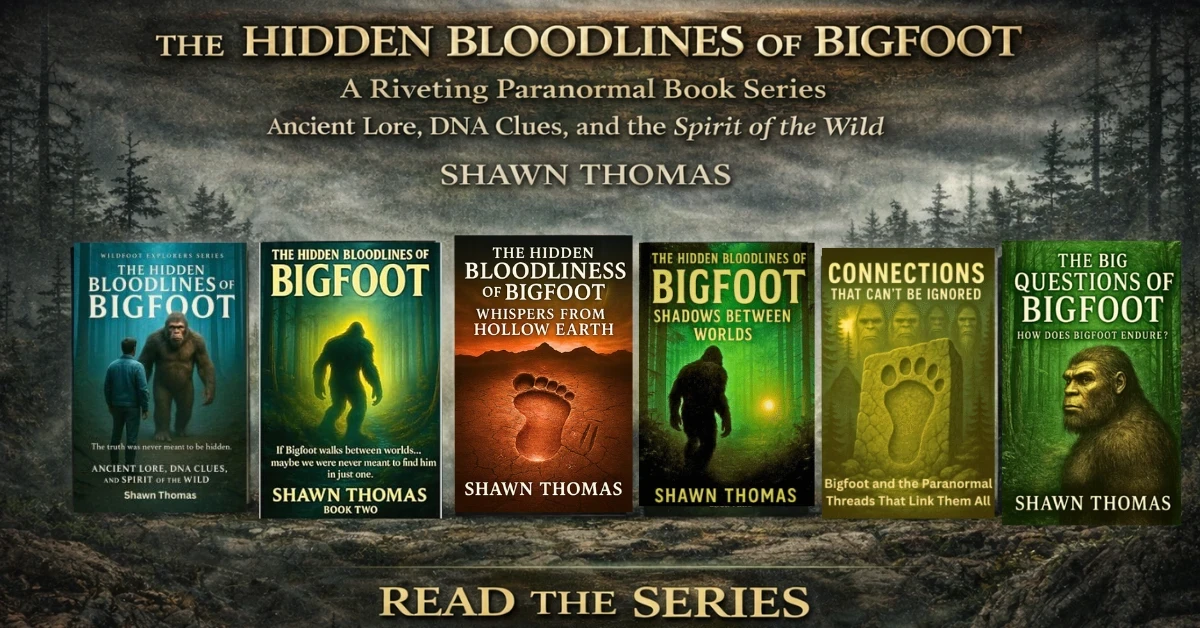
In The Hidden Bloodlines of Bigfoot series, I trace those ancestry patterns through history and modern accounts. Not to force a conclusion but to show the structure already exists.
The Hybrid Theory doesn’t invent mixed ancestry.
It organizes the pattern.
Geographical Anomalies and Government Silence
When you map sightings, they cluster.
Cave systems.
Mountain corridors.
Dense forest networks.
That pattern is consistent with habitat strategy.
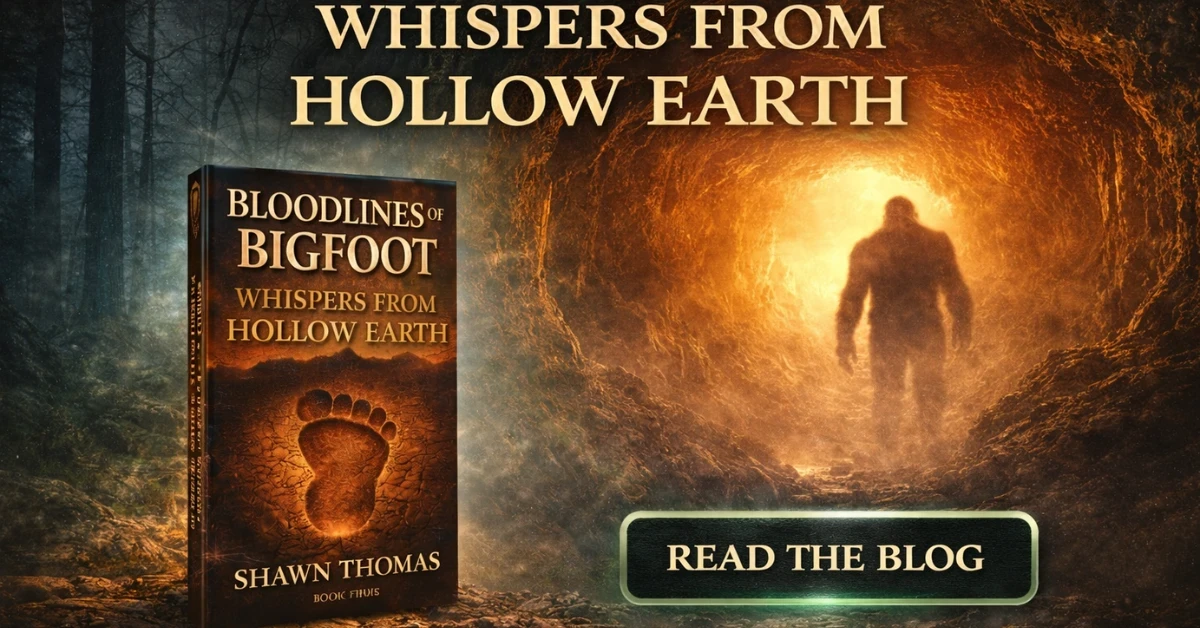
These locations provide cover, retreat routes, and structured movement corridors. If you explore those geographic overlaps deeper, that’s exactly what I examine in Whispers from Hollow Earth not fantasy, but real sighting clusters aligned with terrain.
Then there’s the government question.
If such a being exists and demonstrates intelligence, environmental awareness, and strategic movement, the implications go beyond biology. Conservation, land use, policy it gets complicated fast.
The Hybrid Theory doesn’t require conspiracy.
It recognizes complexity.
The Anchors of the Bridge

At this point in the conversation, a pattern starts to emerge.
Tracks alone don’t explain it.
Witness psychology alone doesn’t explain it.
Genetics alone doesn’t explain it.
Ancient accounts alone don’t explain it.
But together, they begin to act less like mysteries…
and more like components of the same system.
The Hybrid Theory isn’t about forcing a conclusion.
It’s about recognizing when multiple independent fields begin pointing toward the same middle ground.
Not myth replacing science.
Not science replacing experience.
A bridge.
To understand why I lean into that bridge, three anchors stand out.
The Genetic Anchor Proof the Bridge Exists

Science has acknowledged Denisova 11, often called “Denny,” a young girl who lived roughly 90,000 years ago.
Her DNA revealed something remarkable: she was a first-generation hybrid between two separate hominid species a Neanderthal mother and a Denisovan father.
Not symbolic.
Not theoretical.
Biological reality.
Human evolutionary history already contains individuals who existed between branches we once believed were entirely separate.
The idea of a lineage sitting between known branches isn’t pure speculation. Hybridization has occurred before in our evolutionary past.
The bridge, at least in principle, has existed before.
The Historical Anchor The Pattern Was Recorded
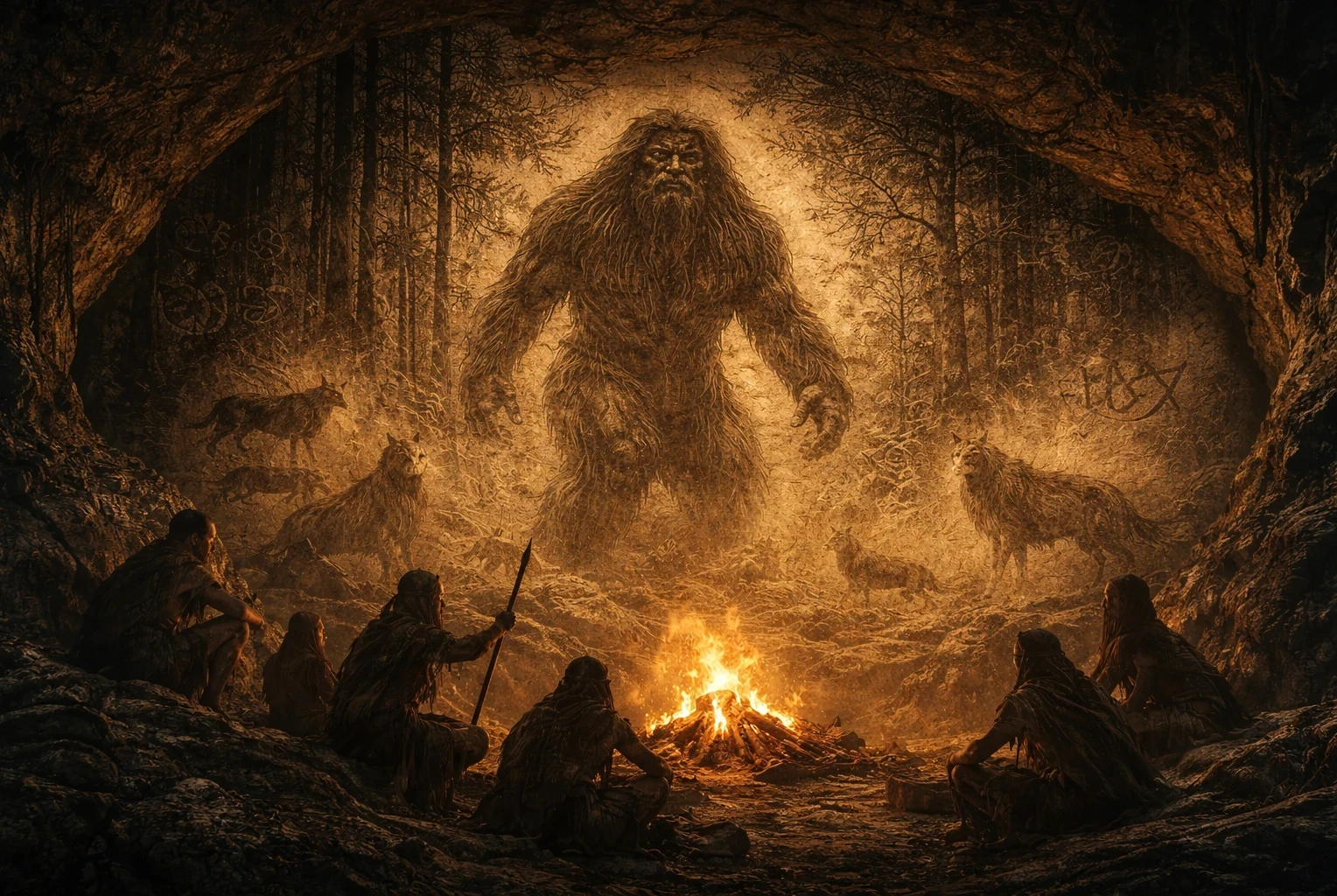
Long before modern debates, ancient cultures documented a figure that does not comfortably sit inside myth or biology alone.
In the Epic of Gilgamesh, the Sumerians described Enkidu a powerful wild man living among animals yet capable of human awareness.
Neither beast nor civilized human.
Existing between worlds.
Across continents, similar figures appear:
Wild men
Forest guardians
Hair-covered watchers
Different cultures.
Similar descriptions.
If a pattern survives thousands of years across cultures without shared communication, it raises the possibility that something persistent was being observed and remembered through story.
The Anatomical Anchor The Body Matches the Middle

Large tracks repeatedly show mid-tarsal flexion a flexible foot structure associated with non-human primates rather than modern humans.
Yet witness descriptions consistently report human-like proportions, facial expression, and awareness.
Not fully human biomechanics.
Not fully ape morphology.
A structure that appears to sit somewhere in between.
When anatomy, history, and genetic precedent begin pointing toward a similar middle ground, it raises the possibility that our categories may be limiting the conversation more than the evidence itself.
The System, Not the Camps

This is where the camps begin to converge.
- The flesh-and-blood perspective explains the physical traces.
- The high-strangeness perspective attempts to account for the unusual encounters.
- The historical accounts explain the longevity of the description.
- The genetic precedent shows that “between states” have existed before.
Instead of competing explanations, these may function as layers of the same phenomenon.
The Hybrid Framework does not claim to solve the mystery.
It attempts to explain why multiple approaches keep touching the same boundary.
Not necessarily because anyone is wrong,
but because each may be observing a different layer of the same phenomenon.

Wildfoot Book Library Affiliate Disclosure
As an Amazon Associate I earn from qualifying purchases. Some links in the Wildfoot Book Library are Amazon affiliate links, which may earn me a small commission at no extra cost to you.
The library includes the books I’ve written and other resources tied to Bigfoot, survival, hidden truths, and the paranormal. Everything here is meant to support your curiosity and exploration.
I only share products and books I personally believe in or created myself. You’ll also find items connected to my other platforms, including Paranormal Curiosities Realm.
Thanks for supporting independent research and storytelling.
Shawn Thomas
Amazon Author & Creator
Founder of Wildfoot Explores and Wildfoot Explores Apparel shop
Psychology of Encounters and Conclusion
People who report encounters often describe something beyond fear.
They describe awareness.
The feeling of being watched, evaluated, measured.
It is not typical predator-prey fear.
It feels like a boundary being tested.
That psychological disruption is powerful. It forces witnesses to question their categories. And our brains prefer clean boxes: animal or spirit, natural or supernatural.
The Hybrid Framework does not sit comfortably inside a single explanatory box.
That is why it can feel uncomfortable.
But discomfort is often where deeper inquiry begins.
Instead of fighting over camps, it may be more productive to recognize the pattern emerging across them.
Biological trace.
Unusual capability.
Structured geography.
Psychological impact.
Ancestral threads.
That is not chaos.
It resembles a system.
If you want to explore that system fully, start with the layer that speaks to you survival, structure, bloodlines, geography, or psychology and then continue examining how the other layers intersect.

Because the longer I’ve studied this phenomenon, the clearer one thing becomes:
The Hybrid Framework isn’t about choosing sides.
It’s about allowing the full pattern to be examined without forcing it into a single explanatory category.
And if this way of thinking resonates with you – if you find yourself standing somewhere between biology and mystery, structure and intuition -then you’re already part of this community.
Wildfoot has never just been about books or theories. It’s about people who aren’t afraid to ask deeper questions and wear that curiosity openly. If you want to carry that mindset beyond the page, take a look at the collection below. The gear represents the bridge just as much as the research does.

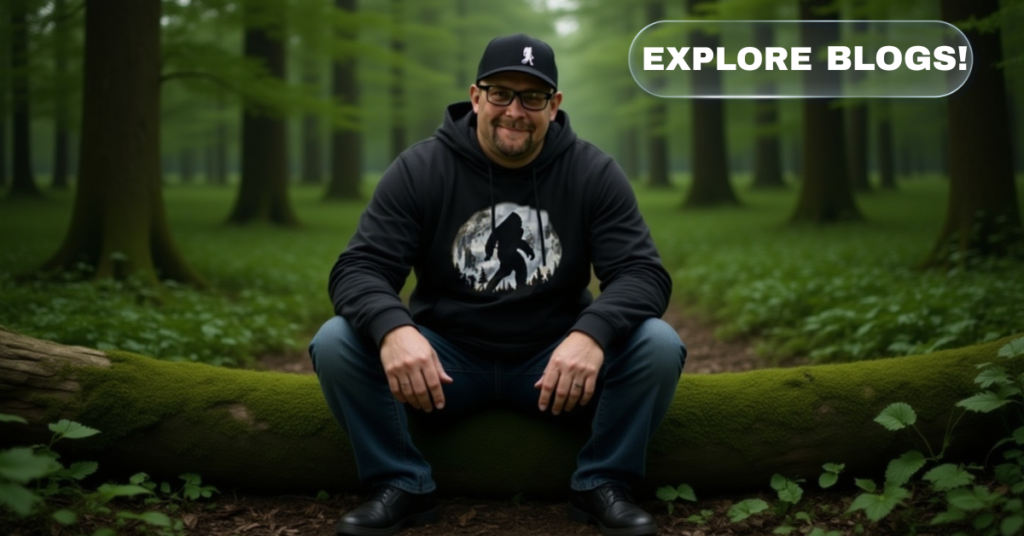

If you enjoyed this blog, the blog, or any of the books in the Wildfoot collection, I’d truly appreciate you taking a moment to leave a review and share your thoughts. Your feedback not only helps others discover the work, it strengthens this entire community of curious minds. Let me know what resonated with you.
Thank you for explaining The hybrid framework, even though I had no idea what it was when coming on your website, it did get my attention and my curiousity to learn more about it.
You have shared in this article very interesting questons with answers, I never thought about why we have never found a Big Foot body untill you mentioned it in this article.
Before reading your article on Big Foot, many of the things you mention has given me more interest to learn more. You can be sure I will bookmark your website to visit often, thank you for such an interesting and informative article.
Jeff
Jeff,
I really appreciate you taking the time to read it and share this.
That means a lot.
The hybrid framework can sound unfamiliar at first, especially if someone hasn’t come across that angle before. My goal was never to complicate things, but to create a bridge that helps explain why certain patterns overlap and why some questions, like the absence of a body, keep resurfacing generation after generation.
Sometimes all it takes is one question being framed slightly differently for curiosity to open up. That curiosity is where the real exploration begins.
I’m glad the article sparked that for you.
Thank you for bookmarking the site and being willing to dig deeper. That kind of open-minded thinking is exactly what keeps this discussion meaningful.
Talk soon,
Shawn
This is such a fascinating deep dive into the “Hybrid Framework.” I’ve always found that the Bigfoot conversation tends to get stuck in two very loud camps—either it’s a flesh-and-blood unclassified primate, or it’s something purely paranormal. Your “bridge” theory is exactly the kind of nuanced middle ground that feels necessary in 2026.
Thanks Leah, I really appreciate that.
That’s exactly the space I was trying to explore with the bridge idea. For a long time the conversation has been stuck between those two loud camps, but when you start looking at the patterns in sightings, behaviors, and cultural stories, it feels like there may be more overlap than people want to admit.
Sometimes the truth sits somewhere in the middle, and that’s the space I think is worth exploring. Thanks for taking the time to read it.
Thank you for this article. It was a fascinating perspective on the Bigfoot mystery and the idea of a hybrid framework connecting different theories. I like how you explored both the biological evidence and the more unusual aspects reported in encounters. Do you think future scientific technology might eventually help confirm or challenge parts of this theory?
Hi Monica, thank you for taking the time to read it and share your thoughts. I really appreciate that.
I do believe future technology is going to play a big role in this conversation. The tools we have today are already far beyond what researchers had even twenty years ago. Environmental DNA sampling, thermal imaging, satellite mapping, and large-scale data analysis are starting to open doors that simply did not exist before.
But I also think technology will only tell part of the story.
One thing that stands out when you study thousands of encounters is that some elements behave like a biological species, while other elements fall into patterns that are harder to explain through traditional zoology alone. That is exactly why the hybrid framework started making sense to me. It allows both sets of observations to sit on the same table without forcing the mystery into only one category.
If future technology confirms physical evidence, it strengthens the biological side of the discussion. If it begins detecting environmental anomalies or patterns around encounters, that may help researchers better understand the stranger aspects people have reported for generations.
Either way, I think the biggest shift we are starting to see is researchers becoming more willing to look at the whole pattern instead of defending only one camp.
And honestly, that shift might be just as important as any new piece of technology.
Thanks again for reading and engaging with the ideas. Conversations like this are exactly how the field moves forward.
I really enjoyed how this article attempts to bring together the various Bigfoot perspectives instead of forcing readers to choose just one camp. It was interesting to see the idea that witness descriptions, biological traces, psychological elements, and even historical and genetic clues can all be part of a larger “bridge” framework that explains more than any single theory alone. The way the article encourages open‑minded exploration without dismissing skepticism made for a thoughtful read. After reading it, I’m curious: which part of the hybrid framework do you personally find most convincing in explaining both the biological and the more unusual aspects of the reported encounters?
Hanna, I really appreciate you taking the time to read that and actually feel what I was trying to do with it.
For me, the most convincing part of the hybrid framework is the overlap itself. It’s when the physical evidence and the experiences start lining up instead of contradicting each other. You’ve got things like tracks, structure, and consistent sighting patterns on one side, and then on the other side you’ve got the silence, the lights, the way encounters don’t always behave like a normal animal interaction.
Individually, each piece can be debated. But when people from completely different places start reporting similar layered experiences, that’s where it stops feeling random and starts looking like a pattern.
That’s really where I stand with it. Not choosing one camp, but looking at where they intersect and asking why that overlap keeps happening.
Thanks again for the thoughtful comment, that’s exactly the kind of conversation that moves this topic forward.
This isn’t something I usually read — I tend to lean more toward general mystery topics — but I came across your article and found the idea of combining different viewpoints interesting. I’m still trying to understand who this approach is aimed at.
Would you say it’s more for people already deep into the Bigfoot topic, or for readers who are just exploring it out of curiosity?
Irina, I really appreciate you asking this, because it’s actually right at the core of what I’m trying to do.
Honestly… it’s meant for both, but probably lands strongest with people who are somewhere in the middle.
If someone is already deep into Bigfoot, they’ll recognize the patterns right away. The overlaps, the repeated behaviors, the strange details that don’t quite fit a purely physical explanation. For them, this kind of framework helps organize things they’ve already seen or heard.
But for someone coming in from general curiosity, like you mentioned, it’s more about offering a different way to look at it without needing years of background. Not “this is what it is,” but “what if this explains why so many of these reports line up?”
That’s really the goal.
I’m not trying to prove anything or push a belief. I’m trying to build a bridge between viewpoints so people can step back and see the patterns instead of just isolated stories.
So if you’re reading it and thinking, “I’m not fully in this, but I’m curious how it connects”… you’re actually exactly the kind of reader I had in mind.
Appreciate you taking the time to check it out and ask that.
This was such a fascinating breakdown of the Hybrid Framework — I really appreciate how you connected biological evidence, historical patterns, and high‑strangeness reports into one cohesive lens. Instead of forcing readers to pick a side, you show how the overlap itself might be the most meaningful part of the conversation. The way you highlight recurring anatomical details, cultural stories, and geographic clustering makes the topic feel grounded rather than sensationalized. It’s a refreshing, open‑minded approach that invites curiosity without dismissing either science or lived experience.
Kiersti, I really appreciate this… you nailed exactly what I was trying to do with that piece.
That idea of not forcing people to “pick a side” is a big one for me. Because the more I’ve looked into this, the more it feels like the argument itself is where people get stuck. Physical vs paranormal, real vs not real… and meanwhile the overlap just keeps showing up over and over again.
That’s the part I can’t ignore.
And I’m glad you picked up on the grounding side of it too. The anatomical details, the locations, the repeated patterns across completely different regions… that’s what keeps it from drifting into just storytelling. There’s something consistent there, even if we don’t fully understand what it is yet.
I’m not trying to close the case on anything. I’m just trying to lay it out in a way where people can step back and say, “okay… something is lining up here.”
Appreciate you taking the time to really see that and put it into words.
Hi Shawn,
I’ve heard a lot of Bigfoot theories over the years, but the idea of using a hybrid framework to explain overlapping sightings and behaviors was actually interesting to read about. What stood out to me was how you approached it more as a pattern analysis instead of just trying to force one explanation onto every encounter.
Some of the regional similarities you mentioned were pretty hard to ignore too. Do you think the overlap between different witness accounts comes more from shared folklore influencing people, or from people genuinely describing the same type of experience independently of each other?
Cheers,
Boris
Hey Boris,
Really appreciate this comment because that question honestly sits right at the center of the entire discussion for me too.
And truthfully, I don’t think the answer is as simple as “it’s all folklore” or “it’s all physical.” I think the reason this topic has survived so long across cultures and generations is because there appears to be a very strange overlap happening between consistent human storytelling and consistent human experience.
Folklore absolutely influences interpretation. I think that’s undeniable. Different cultures will naturally frame unusual encounters through the lens of their beliefs, traditions, environment, and language.
But where it starts becoming difficult to dismiss completely is when you begin comparing independent reports from people who have no connection to each other, sometimes separated by decades or entire continents, yet they describe extremely similar patterns:
the silence,
the feeling of being watched,
the massive humanoid form,
the strange movement,
the environmental reactions,
the vocalizations,
the intimidation behavior,
and sometimes even the high-strangeness elements that appear alongside certain encounters.
That’s the part that keeps pulling researchers back into the subject over and over again.
Personally, I think the overlap becomes most interesting when multiple categories begin colliding together consistently. Not just eyewitness descriptions, but geography, migration corridors, historical records, Indigenous traditions, physical trace reports, and behavioral similarities all stacking on top of one another.
That doesn’t automatically prove one singular explanation of course, but it does suggest there may be an underlying pattern worth taking seriously instead of instantly dismissing.
And honestly, that’s why I lean so heavily into the pattern-analysis side of things rather than trying to claim absolute answers. I think the data itself is often far more interesting than forcing a conclusion too early.
Great question Boris. Comments like this are exactly the kind of conversations that keep the topic productive and grounded.
Thank you for sharing this interesting article about the Bigfoot Bridge and the hybrid framework used to explain overlap in different theories. I found the topic very intriguing because it tries to connect different viewpoints and suggests that seemingly conflicting ideas might actually be parts of a larger, more unified explanation.
I do have a few questions after reading the article. What exactly are the main “overlapping theories” the hybrid framework is trying to bridge, and how are they weighted or evaluated within the model? Also, how do you determine when overlap between ideas is meaningful versus when it is just coincidence or interpretive bias?
I also found the discussion about combining different perspectives interesting because many complex topics whether scientific, cultural, or theoretical often involve multiple interpretations that can seem contradictory at first. It raises the question of whether a hybrid approach helps clarify understanding or risks blending ideas in a way that becomes too broad to test clearl
I think the article encourages thinking about how different theories can interact rather than exist in isolation, which can be a useful way to explore complex or uncertain subjects. Thank you again for sharing this thought-provoking perspective.
Thank you for such a thoughtful comment IYERE, because honestly those are exactly the kinds of questions that need to be asked when discussing a framework like this.
The main overlap the hybrid framework is attempting to examine is the strange consistency between what are usually treated as completely separate categories of reports.
For example:
physical evidence reports,
traditional flesh-and-blood wilderness encounters,
high-strangeness experiences,
Indigenous oral traditions,
environmental anomalies,
and psychological or perceptual effects reported during encounters.
Normally people choose one lane and reject the others entirely. The biological side dismisses anything unusual. The paranormal side sometimes dismisses physical trace evidence. Skeptics may dismiss both categories completely. But what caught my attention over time was that many witness accounts seem to contain overlapping elements from multiple categories simultaneously.
That’s where the “bridge” idea started becoming interesting to me.
Now to your second question, which is probably the most important one:
how do we separate meaningful overlap from coincidence or interpretive bias?
Honestly, that’s the hardest part of the entire subject.
For me personally, meaningful overlap starts becoming worth examining when patterns repeat independently across geography, generations, cultures, and witness backgrounds without direct coordination between those people.
One isolated detail means very little.
But when certain behavioral patterns, environmental effects, descriptions, reactions, or timelines keep surfacing repeatedly across independent reports, that’s when I think it becomes harder to simply dismiss as random coincidence.
That still does not automatically validate a conclusion of course, and I try to be very careful about that.
You also brought up something extremely important about hybrid models potentially becoming “too broad,” and I completely agree that this is a real danger. If a framework attempts to explain everything equally, it risks becoming impossible to properly test or critically evaluate.
That’s why I personally try to approach the hybrid framework more as an observational model rather than a declaration of truth.
Its purpose, at least for me, is not to force all theories together artificially, but to acknowledge that the data itself often refuses to stay neatly separated into only one category.
And honestly, I think that tension between keeping an open mind while still remaining grounded and analytical is probably one of the biggest balancing acts in this entire field.
Really appreciate the depth of your questions here. Conversations like this are what make exploring complex subjects genuinely worthwhile.
I found the idea of using a hybrid framework to explore overlap between different interpretations quite interesting. It made me wonder whether you see these experiences more as psychological/archetypal phenomena, physical encounters, or perhaps a combination of both depending on the situation.
I also appreciated that the article approached the topic from a broader perspective instead of simply trying to force one explanation onto everything. Thank you for sharing your thoughts and research on this.
Thank you for taking the time to read it and for the thoughtful comment.
The honest answer is that I think some reports may fit into different categories. After spending years looking at witness accounts, historical records, and Indigenous traditions, I’ve found it difficult to place every experience into a single box.
Some encounters appear to describe a physical being. Others seem to involve elements that are more psychological, symbolic, spiritual, or archetypal in nature. Then there are reports that seem to contain aspects of both.
Personally, I tend to view the phenomenon through a hybrid lens. Not because it provides an easy answer, but because it seems to account for a wider range of experiences than any single explanation on its own.
What interests me most is not proving one theory correct, but understanding why people from different cultures, backgrounds, and time periods often describe remarkably similar experiences. That question continues to drive my research.
I appreciate you sharing your thoughts and adding to the discussion.
Shawn
There is an old saying: “Round and round in circles we dance and suppose, while wisdom sits in the middle and knows!”. It seems these Bigfoot/Sasquatch stories have persisted over millennia – there has to something real out there that eludes us.
I like the idea of a hybrid “bridge theory” that goes beyond the gestalt of conventional one side or the other thinking.
This looks very good reading material. Where, or what series, would you suggest to someone one who is new to this subject?
Cheers!
Hi Oren,
Thank you for the thoughtful comment. I really like that quote because it fits this subject remarkably well. For decades we’ve tended to debate one explanation against another, but sometimes the truth may lie somewhere in the middle. That’s what led me to explore the hybrid framework in the first place.
For someone who’s just getting into the subject, I’d actually recommend starting with the evidence before diving into the theories. Read about the historical reports, Indigenous oral traditions, eyewitness encounters, and the footprint evidence first. Once you have that foundation, it’s much easier to evaluate the different ideas with an open mind.
That’s also one of the goals of Wildfoot Explores. I try to present multiple perspectives, look for recurring patterns, and encourage people to think critically rather than telling them what they should believe.
I really appreciate you taking the time to read the article and leave such a great question. I’d love to hear where your own research leads as you explore the topic further.
Thanks again!
Shawn
Hi,
As usual this was interesting to read, and I like how you explained the idea in a way that mixes both science and mystery. The way you showed the patterns from different places made the concept easier to understand. It also made me think about why so many stories sound similar. I am a big fan of this kind of series and I used to watch related things on TV. I am just curious would like to ask this, do you think most of these reports come from real experiences, or from people repeating old stories?
Hi Shafna,
Thank you so much! I’m really glad you enjoyed the article. One of my goals with this series is to keep an open mind and explore both the scientific side and the mystery without immediately dismissing either.
That’s a great question. Personally, I don’t think it’s an either-or situation. I’m sure some reports are influenced by folklore, television, or stories people have heard over the years. But I also believe many witnesses are describing genuine experiences that they struggle to explain. What keeps me interested is that so many reports, separated by decades and thousands of miles, often share similar details from people who have never met each other.
That’s why I spend so much time looking for patterns rather than focusing on any single encounter. One report can be mistaken, but when the same themes appear again and again across different regions and cultures, I think it’s worth paying attention.
Thanks again for reading and for asking such a thoughtful question. Comments like yours make these discussions even more enjoyable.
Shawn