
Across cultures and centuries, people continue to describe the same kinds of unexplained encounters. The locations change. The names change. But the behaviors remain strikingly similar.
That realization led to The Architecture of the Unknown a book that steps away from belief debates and focuses on one simple question:
What if the unknown isn’t random?
Explore the Book
The Architecture of the Unknown examines recurring patterns found in cryptid encounters, shadow figures, watchers, and other unexplained experiences across history and culture.
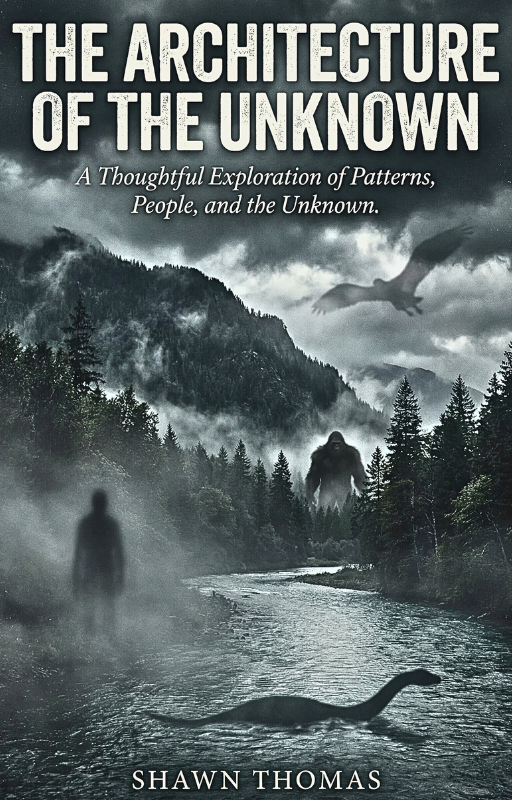
If you’ve ever felt that these stories weren’t isolated, that something connected them beneath the surface, The Architecture of the Unknown was written for you.
As an Amazon Associate I earn from qualifying purchases.

People Also Ask
What does “the architecture of the unknown” mean?
It refers to the recurring patterns found in unexplained encounters across cultures, rather than focusing on proving what these phenomena are.
Why do unexplained encounters seem so similar worldwide?
Many reports share repeating details like location, behavior, and timing, suggesting patterns rather than isolated events.
Is this book about proving cryptids or paranormal beings exist?
No. The book explores patterns and human experiences without trying to prove or disprove belief.
Why do people report feeling watched during unexplained encounters?
That sensation appears repeatedly across cultures and eras, making it one of the most consistent elements of these experiences.
Who is The Architecture of the Unknown written for?
It’s written for curious readers who want a thoughtful, calm exploration of unexplained phenomena without hype or conclusions.
This book isn’t about proving what these phenomena are.
It’s about observing how they appear, how they behave, and why those patterns repeat.
Why I Wrote This Book
After years of reading reports, listening to personal accounts, and comparing stories from around the world, one thing became clear. The same details keep showing up.
Encounters happen at edges, not centers.
Observation happens before interaction.
Recognition often triggers withdrawal.
I wrote The Architecture of the Unknown to document these patterns and offer a clearer, calmer way to think about experiences that are usually dismissed or sensationalized.
The Curiosity That Drives It
This book is built around questions, not conclusions.
Why do unrelated cultures describe similar encounters?
Why do these experiences follow consistent behavioral rules?
Why does the unknown seem aware, but rarely aggressive?
By focusing on patterns instead of explanations, the book invites readers to explore the unknown without forcing belief or disbelief.
Take the Next Step
If you’ve ever felt that these stories weren’t isolated, that something connected them beneath the surface, The Architecture of the Unknown was written for you.

Head’s up Disclosure
Shawn Thomas
Amazon Author & Creator
Founder of Wildfoot Explores and Wildfoot Explores Apparel shop
As an Amazon Associate I earn from qualifying purchases. Some of the links in the Wildfoot Book Library are affiliate links to Amazon. This means I may earn a small commission if you decide to make a purchase, at no extra cost to you. All links are here to explore freely, with no obligation.
The library features books I’ve personally written, connected to the worlds of Bigfoot, hidden truths, survival, and the paranormal. Whether you’re diving into my latest release or exploring trusted gear, every link is designed to support your curiosity and deeper exploration.
I only share books and products I genuinely believe in or have created myself. You’ll also find some items connected to my other platforms, including Paranormal Curiosities Realm.
Thanks for visiting and supporting independent research and storytelling.
This book is designed to challenge how you think, not what you think.



This was interesting to me – “Encounters happen at edges, not centers. Observation happens before interaction. Recognition often triggers withdrawal.’
I wondered about the recognition often triggers withdrawal part. Is it because your brain refuses to accept what you are seeing or you don’t want to see what you are seeing?
All the best with your book. It looks like a great read and I wondered if it is only available online or do you have a book version?
Thank you, Michel, I appreciate you being part of the conversation and engaging with it this thoughtfully.
When I talk about recognition triggering withdrawal, I’m not so much pointing to the brain refusing what it’s seeing, or even fear in the traditional sense. It’s more about a moment of clarity. The encounter often seems to operate in a gray zone of uncertainty until the human fully recognizes that something is there and that it is aware in return. Once that mutual awareness clicks, the encounter tends to end.
It doesn’t feel like denial so much as a boundary being crossed, as if observation is allowed, but acknowledgment is not. That’s one of the reasons this pattern shows up so consistently across very different accounts.
And thank you for the kind words about the book. It’s currently available online, and there is also a physical book version available for those who prefer a printed copy.
Shawn, I liked the way you framed this as pattern-watching instead of belief-fighting. That shift alone lowers the noise. When people stop arguing about whether something is “real,” they start noticing what repeats, and repetition is where the mind begins to map meaning.
Your three lines stayed with me: edges, observation first, recognition triggers withdrawal. That sounds like a rule-set, not a random campfire story. I also found your point about “the presence” hitting the nervous system before the eyes see anything interesting, because it explains why so many accounts start with a body reaction, not a visual.
Here’s what I’m curious about. When you say “patterns,” how do you separate the pattern that belongs to the phenomenon from the pattern that belongs to human psychology, like fear, expectation, and cultural storytelling? And in your research, what is the single most consistent trigger for withdrawal: direct eye contact, sound, human numbers, firearms, or something else?
John
Thank you, John. I really appreciate how carefully you’re engaging with this, and you’re right, once the conversation shifts from belief to pattern, the noise drops and the signal gets clearer.
Separating patterns of the phenomenon from patterns of human psychology is one of the hardest parts of this work. The way I approach it is by looking for elements that persist even when psychology, culture, and expectation should differ. When people from different backgrounds, belief systems, and eras describe the same sequence of events, especially when those sequences include details that don’t serve the storyteller or enhance drama, that’s where the pattern starts to feel external rather than psychological. Fear and expectation vary wildly, but the structure of the encounter often does not.
As for withdrawal, the most consistent trigger I’ve seen isn’t firearms or numbers, and surprisingly not even sound. It’s recognition. The moment the human becomes fully aware and locks attention onto the presence, the interaction tends to end. Eye contact is often part of that, but more broadly it’s the shift from passive observation to mutual acknowledgment. Once that threshold is crossed, withdrawal follows.
That behavior feels less like an animal response and more like a rule being obeyed, a boundary that can be approached, but not crossed.
This article touches on something deeply compelling: the idea that the unknown is not chaotic, but structured in ways we only begin to recognize once we pay attention. I appreciate how you frame the unknown not as a void to be feared, but as an architecture that reveals itself through patterns, symbols, and recurring forms across cultures and stories.
What resonated with me is how these patterns seem to arise independently of geography. While much attention is often given to creatures and myths from distant or exotic regions, Europe itself is rich with extraordinary beings, folkloric creatures, and symbolic archetypes that follow similar structural patterns. From forest spirits and water beings to hybrid guardians and liminal creatures, the same underlying logic appears again and again. Different names, different skins, but a familiar architecture beneath.
This makes me wonder whether the unknown is less about discovery and more about remembrance. Perhaps these patterns persist because they reflect something fundamental about human perception, nature, and meaning rather than isolated cultural inventions.
My question is this: when you study these recurring structures of the unknown, do you see European mythological creatures and folklore as part of the same global architecture, and if so, how consciously did they influence your thinking while writing the book?
Thank you, Farid. That’s an incredibly thoughtful reflection, and you articulated something central to the heart of the book.
Yes, I absolutely see European folklore and mythological beings as part of the same global architecture. In many ways, they were essential to my thinking. When you strip away names, regions, and time periods, the same structures keep appearing: liminal guardians, forest and water entities, hybrid forms, boundary keepers, watchers rather than attackers. Europe is especially rich in these patterns, and I think it’s often overlooked because familiarity dulls our sense of wonder.
Your point about remembrance resonates strongly with me. The work increasingly felt less like discovering something new and more like recognizing something old that never fully left us. These patterns don’t behave like isolated stories invented for entertainment. They behave like recurring symbols tied to human perception, landscape, and thresholds, physical and psychological.
So while the book draws from many regions, European traditions were very much part of the framework, consciously and unconsciously. They helped reinforce the idea that the unknown isn’t random or chaotic, but structured, consistent, and quietly persistent across cultures.
Thank you for sharing a very interesting topic. It does appear the unknown seems aware, but rarely aggressive, if at all. You mentioned that your book is built around questions. So I am wondering if they will ever be answered? And if (when) they are answered, how do you anticipate they will be answered?
Thank you, Kent, I really appreciate the way you framed that. That observation about awareness without aggression is exactly one of the threads that kept pulling me deeper into this work.
The book is built around questions because, at least right now, the most honest answers don’t come from declaring conclusions, but from recognizing consistent patterns. Some questions may eventually be answered through better data, shared experiences, or shifts in how we’re willing to study the unknown. Others may only ever be answered partially, or not at all, and I think that’s important to acknowledge.
If answers do come, I don’t expect them to arrive as a single revelation, but gradually, through accumulation, comparison, and the willingness to rethink old assumptions. The goal of the book isn’t to close the door on the mystery, but to frame it in a way that lets clearer understanding emerge over time.
Ton projet est vraiment inspirant, Shawn. Ce que j’apprécie, c’est que tu ne cherches pas à imposer une vérité, mais à inviter à la réflexion. Tes extraits montrent bien que ton livre n’est pas une quête sensationnaliste, mais une exploration patiente des motifs qui relient ces expériences à travers cultures et époques. L’idée que “l’architecture de l’inconnu” questionne notre manière de penser plutôt que nos croyances est une approche rare et précieuse. Merci pour ton authenticité et ta passion — elles donnent envie de plonger dans ton univers et de soutenir cette recherche indépendante.
Réponse en français
Merci beaucoup pour ce message, il me touche sincèrement. C’est exactement l’intention derrière ce travail : ne rien imposer, mais inviter à une réflexion posée autour des motifs qui se répètent, quelles que soient les cultures ou les époques. Le fait que tu aies ressenti cette approche me confirme que le livre va là où il doit aller. Merci pour ton soutien et pour ton regard attentif.
English reply
Thank you so much for this thoughtful comment, it truly means a lot to me. That is exactly the intention behind this work: not to impose conclusions, but to invite calm, open reflection on the patterns that keep appearing across cultures and time. Knowing that this approach resonated with you tells me the book is doing what it was meant to do. I really appreciate your support and the care you brought to reading it.