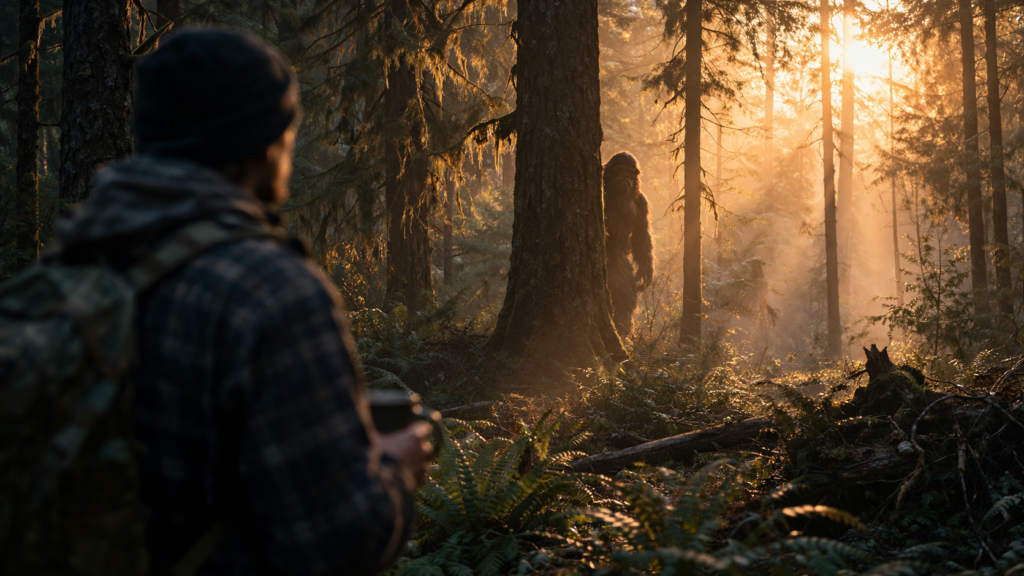
This Didn’t Start As A Theory… It Started As A Conflict
For a long time, I sat firmly in the hybrid camp. Not partially, not cautiously, but fully committed to the idea that what people were encountering existed somewhere between categories. I wrote about it, built content around it, and believed we were dealing with something that was both physical and something more. At the time, that explanation felt right, because when you first step into this topic, it naturally presents itself that way. It feels like a blend of realities that refuses to sit cleanly in any single box.
But the deeper I went into this, the more something began to feel off. It wasn’t the encounters themselves, and it wasn’t the people sharing them. What started to stand out was the lack of alignment between what people were experiencing and how we were explaining it. That gap became impossible to ignore. The more I listened, compared, and broke things down, the clearer it became that the issue wasn’t a lack of evidence. It was a mismatch between pattern and interpretation. That realization marked the turning point, because once the patterns became visible, the old explanation stopped holding up.
This Is Not Opinion… This Is Volume

Before getting into the patterns, it’s important to establish where this is coming from. This isn’t built on a handful of stories or a few isolated encounters. It comes from scale. Over the past year, I’ve had millions of views across my content, thousands of comments, and hundreds of direct conversations with people sharing what they’ve experienced. That includes messages I’ve taken the time to read fully, as well as real conversations I’ve had while out on the road trucking.
None of that was treated as entertainment. I approached it as data. Instead of focusing on what sounded interesting or what supported a specific belief, I focused on what repeated. When you take that approach, something changes. The randomness starts to disappear, and structure begins to emerge. What initially looks like scattered encounters starts to form a consistent sequence, and that sequence is where this entire shift in perspective comes from.




Pattern #1: The Environment Always Shifts First
One of the most consistent patterns across every type of encounter is that the environment changes before anything is seen. People describe this in remarkably similar ways, regardless of where they are or what they believe they encountered. The forest goes quiet, often abruptly. Sound drops off in a way that feels unnatural, and the air itself begins to feel heavier, almost as if pressure has been introduced into the space.
What makes this significant is not just the consistency of the description, but the fact that it appears across all camps. It doesn’t matter whether someone interprets the encounter as a physical being, something rooted in ancient lineage, or something beyond conventional explanation. The beginning of the experience follows the same structure. That consistency challenges the idea that these are separate phenomena. When completely different interpretations share the exact same starting conditions, it suggests that the division may not exist where we think it does.
Pattern 2: Awareness Before Visual


The second pattern builds directly from the first and introduces an even more compelling layer to the experience. People consistently report a sense of awareness before any visual confirmation takes place. This isn’t a vague feeling or a general sense of unease. It is a clear and distinct recognition that something is present, even though nothing has yet been seen.
This shifts the nature of the encounter away from being purely visual and suggests that it begins on a different level entirely. The experience is already in motion before the sighting occurs. Whether the person ultimately sees a full figure, a partial shape, or nothing at all, that awareness appears first with remarkable consistency. This repeated sequence points away from random encounters and toward something that follows a defined structure.
Pattern #3: The Encounter Splits Here (This Is Where Camps Form)

Up until this point, the structure of the experience is remarkably consistent. The environment shifts, the pressure builds, and awareness sets in before anything is seen. But once the encounter reaches its peak, something changes. This is where the experience begins to divide, and where the three major camps are formed.
Some people report seeing a fully physical figure, clear shape, movement, and presence that aligns with a biological being. Others describe something less defined, more shadow-like, or partially visible, as if what they’re observing isn’t fully anchored in the environment. And then there are those who never see anything at all, yet walk away with complete certainty that something was there. The experience itself doesn’t break down, but the outcome varies, and that variation is what creates the divide.
This distinction matters because it shows that the disagreement between camps does not come from how the encounter begins. It comes from how it resolves. The same sequence leads to different endpoints, and those endpoints shape belief. When you recognize that, it becomes harder to argue that these are entirely separate phenomena. Instead, it begins to look like a single experience with multiple forms of expression.
The Three Camps (And Why They Exist)

Once the encounter reaches that branching point, interpretation takes over. This is where people begin to make sense of what they experienced, and where the three dominant perspectives emerge. Each camp is built on the same foundational experience, but filtered through a different lens.

The flesh-and-blood perspective focuses on the physical aspects of the encounter. People in this camp look at tracks, movement, sound, and environmental interaction, and interpret what they experienced as an undiscovered biological species. From their viewpoint, the consistency of physical evidence supports the idea of something real and grounded in our world.



The ancient lineage perspective takes a broader view, connecting these encounters to historical and cultural records. This interpretation draws from oral traditions, folklore, and long-standing accounts of beings that have existed alongside humans for generations. Rather than seeing the phenomenon as newly discovered, this camp views it as something deeply rooted in human history.
The interdimensional perspective focuses on the elements that don’t align with standard biological explanations. Sudden appearances, disappearances, distortions, and environmental anomalies point toward something that interacts with reality differently. From this standpoint, the experience suggests a phenomenon that is not fully bound by the same rules as the physical world.

What’s important is not which camp is correct, but the fact that all three are built from the same starting sequence. The division happens after the encounter, not during it. That realization shifts the focus away from arguing over conclusions and toward examining the shared structure underneath them.
Walking Through The Experience Step By Step

To understand this fully, it helps to remove all labels and follow the experience as it unfolds. Imagine being in the woods with everything feeling normal. The environment is calm, familiar, and predictable. Then the shift occurs. Sound drops off, the atmosphere changes, and something about the space no longer feels right. It’s subtle, but undeniable.
Before anything is seen, awareness sets in. There is a clear recognition that something is present, even without visual confirmation. This is not guesswork or imagination. It is a direct, internal signal that something in the environment has changed and that presence is now part of it.
As the moment builds, the encounter reaches its peak. This is where the variation occurs. Some individuals see a fully formed figure, others perceive something less defined, and some never see anything at all. Despite that difference, the experience itself remains intact. The structure does not break, only the outcome shifts.
Then, just as consistently as it began, the encounter ends. It does not spiral or collapse into chaos. Instead, it resolves in a controlled and deliberate way. The presence leaves, fades, or simply is no longer there. Immediately afterward, the environment resets. Sound returns, the pressure lifts, and everything appears normal again.
What remains is the impact of the experience itself. The person may leave the area, but the structure of what happened stays with them. And when that same structure appears across thousands of accounts, it becomes difficult to dismiss as coincidence.
Looking At It As A System
Once you step back from the individual details and remove the labels people attach to their experiences, what remains is a consistent sequence. The environment shifts, awareness builds, the encounter occurs, the moment ends, and everything resets. This progression shows up across a wide range of reports, regardless of location, belief system, or outcome.
What makes this important is not just that the sequence exists, but that it repeats with enough consistency to suggest structure rather than randomness. When a process unfolds in the same order across different encounters, it begins to resemble a system. It no longer looks like isolated events happening by chance. Instead, it appears to follow a pattern that governs how the experience begins, develops, and concludes.
This shift in perspective changes how the phenomenon is approached. Instead of focusing on what people think they encountered, attention moves toward how the encounter behaves. Behavior is measurable through repetition. Interpretation is not. By focusing on the sequence rather than the conclusion, the experience becomes something that can be studied in a more grounded and consistent way.


The Full Breakdown Across All Three Camps
When that sequence is placed alongside the three dominant interpretations, a clear relationship begins to emerge. Each camp describes the experience differently, but the underlying structure remains intact. The differences appear in how the experience is interpreted, not in how it unfolds.
| Phase | Flesh and Blood | Ancient Lineage | Interdimensional |
|---|---|---|---|
| Trigger | Environmental silence | Atmospheric dread | Environmental shift |
| Input | Instinctive awareness | Deep recognition | Mental pressure |
| Output | Physical form and movement | Guardian-like presence | Distortion or shadow form |
| Exit | Moves away or disappears | Withdraws or vanishes | Dissolves or resets |
Looking at this side by side makes something very clear. The structure does not change. The trigger is always present, the awareness always follows, and the encounter always resolves in a controlled way. What changes is the interpretation of each phase.
This is the point where the argument between camps begins to weaken. If the same structure supports all three explanations, then the division may not be rooted in separate phenomena. Instead, it may come from how people process and describe what they experienced.
The Pattern That Doesn’t Change
Across all interpretations, several elements remain consistent. There is always a sense of presence before any visual confirmation. That presence is often described as aware, not passive, suggesting some level of intelligence behind it. The environment itself becomes part of the experience, whether through sound suppression, pressure, or subtle changes in atmosphere.
Even in encounters that lean toward the paranormal, there is often some form of physical interaction. Movement in the environment, displaced objects, or sound all indicate that the experience is not purely internal. At the same time, it does not behave like a typical animal encounter. The controlled nature of both the beginning and the end separates it from standard wildlife behavior.
This combination of consistency and variation is what makes the phenomenon difficult to categorize. The experience remains stable in its structure, but flexible in how it presents itself. That tension is what has kept the debate alive, but it is also what points toward a deeper connection between the camps.
The Main Connection
At the center of all of this is a simple but critical observation. The experience itself remains consistent, while the explanation changes. That distinction is what drives the divide. People are not arguing over completely different events. They are interpreting the same structured experience through different frameworks.
Once that is understood, the focus begins to shift. The question is no longer which explanation is correct, but why the same experience leads to different conclusions. That shift moves the conversation away from belief and toward pattern recognition, which provides a more stable foundation for understanding what is happening.

Pattern #4: The Exit Is Always Controlled
Another consistent element across encounters is how they end. These experiences do not dissolve into chaos or escalate unpredictably. Instead, they resolve in a controlled and deliberate way. The presence withdraws, fades, or simply ceases to be part of the environment.
This controlled exit suggests that the encounter is not random or reactive. It appears to follow a boundary, as if there is a defined limit to how long the interaction lasts. That behavior stands out because it does not match typical animal encounters, which are often driven by instinct and can escalate quickly.
The consistency of this ending across different reports reinforces the idea that the experience follows a structured progression. It begins under certain conditions, develops in a recognizable way, and ends with the same level of control.

Pattern #5: The Environment Resets
Immediately following the exit, the environment returns to its normal state. Sound resumes, the pressure lifts, and the atmosphere stabilizes. The same space that felt altered moments before now appears completely ordinary.
This reset is just as important as the initial shift. It completes the sequence and reinforces the idea that the encounter operates within a defined structure. The environment is not permanently changed. It is temporarily affected, then restored.
For the person experiencing it, this creates a sharp contrast. The shift into the encounter is noticeable, and the return to normal is just as clear. That contrast leaves a lasting impression, even if the details of what was seen or not seen remain uncertain.
Why This Changes The Entire Conversation
When everything is laid out together, the original hybrid idea starts to feel incomplete. It’s not that it was entirely wrong, but it doesn’t fully explain what the patterns are showing. A hybrid suggests a mixture of different things, but what we’re seeing here doesn’t behave like a mixture. It behaves like a consistent structure that presents itself in different ways.
That distinction matters because it shifts the direction of the conversation. Instead of asking what this is made of, the focus moves toward how it behaves. Behavior can be tracked through repetition. It can be compared, analyzed, and understood over time. Interpretation, on the other hand, is shaped by perspective, belief, and personal experience. When those two are separated, the patterns become much clearer.
By focusing on behavior, the argument between camps begins to lose its foundation. The differences remain, but they no longer define the entire discussion. What becomes more important is the shared structure that appears underneath every interpretation.
What If It’s Not Three Types… But Three States?

This is where the perspective shifts further. Instead of viewing these encounters as three separate types of beings, it may be more accurate to consider them as different states of the same phenomenon. The structure remains consistent, but the level of interaction changes.
In some cases, the presence appears fully physical, with clear movement and environmental impact. In others, it presents in a partial or unclear form, blending into the environment or appearing less defined. There are also experiences where no visual confirmation occurs at all, yet the awareness and environmental changes are still present.
Viewing these as states rather than separate categories removes the need to divide the phenomenon into competing explanations. It allows for variation within a consistent system, rather than forcing entirely different interpretations to stand on their own. This approach doesn’t claim to solve the mystery, but it does provide a framework that better matches the patterns being observed.


Where The Mind Comes Into This
Another layer that cannot be ignored is how the human mind processes these experiences. The encounter itself follows a structure, but the way it is remembered and described is influenced by perception. People interpret what they experience based on what they already understand, believe, or expect.
This does not mean the experience is imagined or created by the mind. It means the interpretation is shaped by it. The same event can be described in different ways depending on the individual, which helps explain why the three camps exist. The division happens after the encounter, not during it.
Understanding this distinction is important because it allows for different perspectives without dismissing the underlying experience. It creates space for multiple interpretations while still recognizing the consistent structure that connects them.
Even Shadow Encounters Start Lining Up

As the patterns are compared across different types of encounters, the overlap becomes more difficult to ignore. Elements such as presence, awareness, and the feeling of being observed appear in multiple contexts, not just within one category.
These similarities suggest that what people are experiencing may not be as separate as it appears on the surface. Different labels are applied depending on the situation, but the core experience continues to follow the same structure. That consistency raises questions about whether these encounters are connected at a deeper level.
This does not mean every experience is the same, but it does suggest that the boundaries between categories may not be as clear as they seem. When patterns repeat across different contexts, it becomes necessary to consider the possibility of a shared underlying process.
Why This Matters
The importance of this perspective lies in what it allows us to do moving forward. Instead of focusing on proving one interpretation over another, attention can shift toward understanding the structure of the experience itself. This creates a more stable foundation for discussion and analysis.
When people step back from defending positions and start examining patterns, the conversation becomes more productive. It opens the door to new ways of thinking about the phenomenon without dismissing the experiences that led people to their conclusions in the first place.
This approach does not provide a final answer, but it does offer a clearer way of asking better questions. And in a topic like this, asking the right question is often more important than forcing an immediate answer.

People Also Ask
Why are Bigfoot encounters so different?
Because the interpretation varies, even when the underlying experience is the same.
What is the awareness feeling people describe?
It’s one of the most consistent early-stage patterns before any visual occurs.
Is Bigfoot physical or paranormal?
The pattern suggests it may not be limited to a single category.
Are shadow beings connected to this?
There are overlapping patterns that suggest a possible connection worth exploring.

Why do people argue so much about this topic?
Because they’re debating interpretations instead of examining the shared structure of the experience.
Final Thought
One of the reasons this subject has remained unresolved for so long may be that too much attention has been placed on the outcome of the experience rather than the process itself. When the focus is on what was seen, the conversation naturally divides. But when the focus shifts to how the experience unfolds, a consistent structure begins to appear.
That structure shows up across different people, locations, and interpretations. The beginning follows the same pattern, the progression remains consistent, and the ending resolves in a similar way. The only part that changes is how the experience is interpreted afterward.
This raises a different kind of question. Instead of asking what this is, it becomes more useful to ask why the experience remains consistent while the interpretation varies. That question moves the conversation away from competing explanations and toward a deeper examination of the patterns themselves.
And once that shift happens, the subject stops being just about identifying something unknown. It becomes about understanding how that unknown behaves within the environment and within the experience itself.

Head’s up affiliate Disclosure
As an Amazon Associate I earn from qualifying purchases. Some of the links in the Wildfoot Book Library are affiliate links to Amazon. This means I may earn a small commission if you decide to make a purchase, at no extra cost to you. All links are here to explore freely, with no obligation.
Thanks for visiting and supporting independent research and storytelling.
Thanks for supporting independent research and storytelling.
Shawn Thomas
Amazon Author & Creator
Founder of Wildfoot Explores and Wildfoot Explores Apparel shop



As a single mom who spends my days juggling a million different tasks, I really felt seen by the way you described how we often overlook the underlying patterns of our busy lives. It’s so easy to stay in survival mode, but your perspective on stepping back to see the “why” behind our routines is exactly the wake-up call I needed. I’m definitely going to try and apply this mindset shift tonight once the kids are finally asleep and I have a moment to breathe!
Leah, this one hit me.
That “survival mode” you mentioned… that’s real life for a lot of people, especially when you’re carrying that much on your shoulders every single day. It’s not that you don’t want to step back and see the patterns… it’s that most days don’t give you the space to even think about it.
And that’s why what you said matters.
It’s not about some big overhaul or changing everything overnight. Sometimes it’s just that one quiet moment at the end of the day… when everything finally settles… and you get a chance to ask yourself, “why does my day keep looking like this?”
That’s where it starts.
Not with pressure. Not with perfection. Just awareness.
The fact that you’re even thinking about trying this tonight tells me you’re already shifting out of that survival loop, even if it’s just a small step.
Appreciate you sharing this. That perspective is powerful.