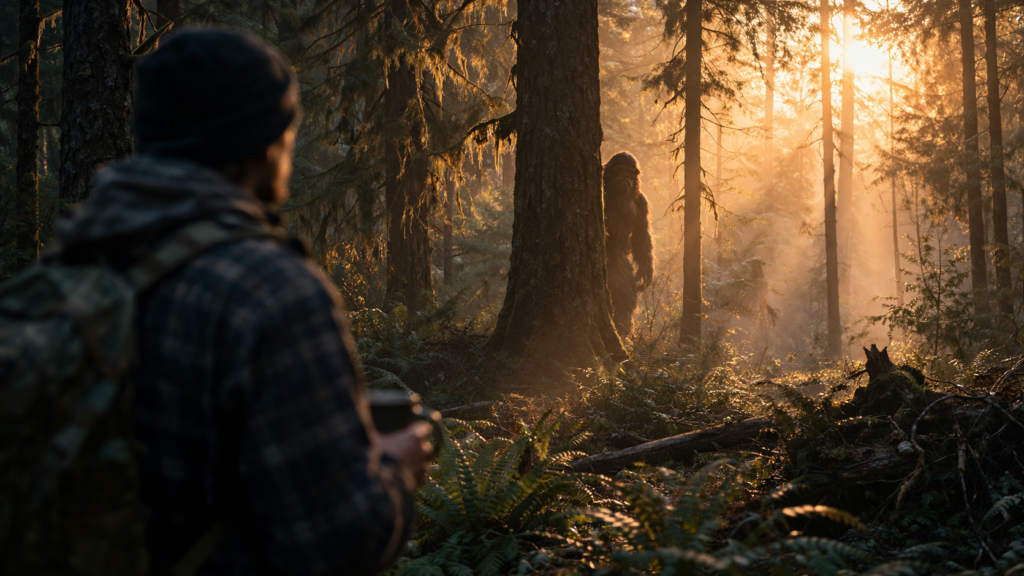
This Didn’t Start As A Theory… It Started As A Conflict
For a long time, I sat firmly in the hybrid camp. Not partially, not cautiously, but fully committed to the idea that what people were encountering existed somewhere between categories. I wrote about it, built content around it, and believed we were dealing with something that was both physical and something more. At the time, that explanation felt right, because when you first step into this topic, it naturally presents itself that way. It feels like a blend of realities that refuses to sit cleanly in any single box.
But the deeper I went into this, the more something began to feel off. It wasn’t the encounters themselves, and it wasn’t the people sharing them. What started to stand out was the lack of alignment between what people were experiencing and how we were explaining it. That gap became impossible to ignore. The more I listened, compared, and broke things down, the clearer it became that the issue wasn’t a lack of evidence. It was a mismatch between pattern and interpretation. That realization marked the turning point, because once the patterns became visible, the old explanation stopped holding up.
This Is Not Opinion… This Is Volume

Before getting into the patterns, it’s important to establish where this is coming from. This isn’t built on a handful of stories or a few isolated encounters. It comes from scale. Over the past year, I’ve had millions of views across my content, thousands of comments, and hundreds of direct conversations with people sharing what they’ve experienced. That includes messages I’ve taken the time to read fully, as well as real conversations I’ve had while out on the road trucking.
None of that was treated as entertainment. I approached it as data. Instead of focusing on what sounded interesting or what supported a specific belief, I focused on what repeated. When you take that approach, something changes. The randomness starts to disappear, and structure begins to emerge. What initially looks like scattered encounters starts to form a consistent sequence, and that sequence is where this entire shift in perspective comes from.




Pattern #1: The Environment Always Shifts First
One of the most consistent patterns across every type of encounter is that the environment changes before anything is seen. People describe this in remarkably similar ways, regardless of where they are or what they believe they encountered. The forest goes quiet, often abruptly. Sound drops off in a way that feels unnatural, and the air itself begins to feel heavier, almost as if pressure has been introduced into the space.
What makes this significant is not just the consistency of the description, but the fact that it appears across all camps. It doesn’t matter whether someone interprets the encounter as a physical being, something rooted in ancient lineage, or something beyond conventional explanation. The beginning of the experience follows the same structure. That consistency challenges the idea that these are separate phenomena. When completely different interpretations share the exact same starting conditions, it suggests that the division may not exist where we think it does.
Pattern 2: Awareness Before Visual


The second pattern builds directly from the first and introduces an even more compelling layer to the experience. People consistently report a sense of awareness before any visual confirmation takes place. This isn’t a vague feeling or a general sense of unease. It is a clear and distinct recognition that something is present, even though nothing has yet been seen.
This shifts the nature of the encounter away from being purely visual and suggests that it begins on a different level entirely. The experience is already in motion before the sighting occurs. Whether the person ultimately sees a full figure, a partial shape, or nothing at all, that awareness appears first with remarkable consistency. This repeated sequence points away from random encounters and toward something that follows a defined structure.
Pattern #3: The Encounter Splits Here (This Is Where Camps Form)

Up until this point, the structure of the experience is remarkably consistent. The environment shifts, the pressure builds, and awareness sets in before anything is seen. But once the encounter reaches its peak, something changes. This is where the experience begins to divide, and where the three major camps are formed.
Some people report seeing a fully physical figure, clear shape, movement, and presence that aligns with a biological being. Others describe something less defined, more shadow-like, or partially visible, as if what they’re observing isn’t fully anchored in the environment. And then there are those who never see anything at all, yet walk away with complete certainty that something was there. The experience itself doesn’t break down, but the outcome varies, and that variation is what creates the divide.
This distinction matters because it shows that the disagreement between camps does not come from how the encounter begins. It comes from how it resolves. The same sequence leads to different endpoints, and those endpoints shape belief. When you recognize that, it becomes harder to argue that these are entirely separate phenomena. Instead, it begins to look like a single experience with multiple forms of expression.
The Three Camps (And Why They Exist)

Once the encounter reaches that branching point, interpretation takes over. This is where people begin to make sense of what they experienced, and where the three dominant perspectives emerge. Each camp is built on the same foundational experience, but filtered through a different lens.

The flesh-and-blood perspective focuses on the physical aspects of the encounter. People in this camp look at tracks, movement, sound, and environmental interaction, and interpret what they experienced as an undiscovered biological species. From their viewpoint, the consistency of physical evidence supports the idea of something real and grounded in our world.



The ancient lineage perspective takes a broader view, connecting these encounters to historical and cultural records. This interpretation draws from oral traditions, folklore, and long-standing accounts of beings that have existed alongside humans for generations. Rather than seeing the phenomenon as newly discovered, this camp views it as something deeply rooted in human history.
The interdimensional perspective focuses on the elements that don’t align with standard biological explanations. Sudden appearances, disappearances, distortions, and environmental anomalies point toward something that interacts with reality differently. From this standpoint, the experience suggests a phenomenon that is not fully bound by the same rules as the physical world.

What’s important is not which camp is correct, but the fact that all three are built from the same starting sequence. The division happens after the encounter, not during it. That realization shifts the focus away from arguing over conclusions and toward examining the shared structure underneath them.
Walking Through The Experience Step By Step

To understand this fully, it helps to remove all labels and follow the experience as it unfolds. Imagine being in the woods with everything feeling normal. The environment is calm, familiar, and predictable. Then the shift occurs. Sound drops off, the atmosphere changes, and something about the space no longer feels right. It’s subtle, but undeniable.
Before anything is seen, awareness sets in. There is a clear recognition that something is present, even without visual confirmation. This is not guesswork or imagination. It is a direct, internal signal that something in the environment has changed and that presence is now part of it.
As the moment builds, the encounter reaches its peak. This is where the variation occurs. Some individuals see a fully formed figure, others perceive something less defined, and some never see anything at all. Despite that difference, the experience itself remains intact. The structure does not break, only the outcome shifts.
Then, just as consistently as it began, the encounter ends. It does not spiral or collapse into chaos. Instead, it resolves in a controlled and deliberate way. The presence leaves, fades, or simply is no longer there. Immediately afterward, the environment resets. Sound returns, the pressure lifts, and everything appears normal again.
What remains is the impact of the experience itself. The person may leave the area, but the structure of what happened stays with them. And when that same structure appears across thousands of accounts, it becomes difficult to dismiss as coincidence.
Looking At It As A System
Once you step back from the individual details and remove the labels people attach to their experiences, what remains is a consistent sequence. The environment shifts, awareness builds, the encounter occurs, the moment ends, and everything resets. This progression shows up across a wide range of reports, regardless of location, belief system, or outcome.
What makes this important is not just that the sequence exists, but that it repeats with enough consistency to suggest structure rather than randomness. When a process unfolds in the same order across different encounters, it begins to resemble a system. It no longer looks like isolated events happening by chance. Instead, it appears to follow a pattern that governs how the experience begins, develops, and concludes.
This shift in perspective changes how the phenomenon is approached. Instead of focusing on what people think they encountered, attention moves toward how the encounter behaves. Behavior is measurable through repetition. Interpretation is not. By focusing on the sequence rather than the conclusion, the experience becomes something that can be studied in a more grounded and consistent way.


The Full Breakdown Across All Three Camps
When that sequence is placed alongside the three dominant interpretations, a clear relationship begins to emerge. Each camp describes the experience differently, but the underlying structure remains intact. The differences appear in how the experience is interpreted, not in how it unfolds.
| Phase | Flesh and Blood | Ancient Lineage | Interdimensional |
|---|---|---|---|
| Trigger | Environmental silence | Atmospheric dread | Environmental shift |
| Input | Instinctive awareness | Deep recognition | Mental pressure |
| Output | Physical form and movement | Guardian-like presence | Distortion or shadow form |
| Exit | Moves away or disappears | Withdraws or vanishes | Dissolves or resets |
Looking at this side by side makes something very clear. The structure does not change. The trigger is always present, the awareness always follows, and the encounter always resolves in a controlled way. What changes is the interpretation of each phase.
This is the point where the argument between camps begins to weaken. If the same structure supports all three explanations, then the division may not be rooted in separate phenomena. Instead, it may come from how people process and describe what they experienced.
The Pattern That Doesn’t Change
Across all interpretations, several elements remain consistent. There is always a sense of presence before any visual confirmation. That presence is often described as aware, not passive, suggesting some level of intelligence behind it. The environment itself becomes part of the experience, whether through sound suppression, pressure, or subtle changes in atmosphere.
Even in encounters that lean toward the paranormal, there is often some form of physical interaction. Movement in the environment, displaced objects, or sound all indicate that the experience is not purely internal. At the same time, it does not behave like a typical animal encounter. The controlled nature of both the beginning and the end separates it from standard wildlife behavior.
This combination of consistency and variation is what makes the phenomenon difficult to categorize. The experience remains stable in its structure, but flexible in how it presents itself. That tension is what has kept the debate alive, but it is also what points toward a deeper connection between the camps.
The Main Connection
At the center of all of this is a simple but critical observation. The experience itself remains consistent, while the explanation changes. That distinction is what drives the divide. People are not arguing over completely different events. They are interpreting the same structured experience through different frameworks.
Once that is understood, the focus begins to shift. The question is no longer which explanation is correct, but why the same experience leads to different conclusions. That shift moves the conversation away from belief and toward pattern recognition, which provides a more stable foundation for understanding what is happening.

Pattern #4: The Exit Is Always Controlled
Another consistent element across encounters is how they end. These experiences do not dissolve into chaos or escalate unpredictably. Instead, they resolve in a controlled and deliberate way. The presence withdraws, fades, or simply ceases to be part of the environment.
This controlled exit suggests that the encounter is not random or reactive. It appears to follow a boundary, as if there is a defined limit to how long the interaction lasts. That behavior stands out because it does not match typical animal encounters, which are often driven by instinct and can escalate quickly.
The consistency of this ending across different reports reinforces the idea that the experience follows a structured progression. It begins under certain conditions, develops in a recognizable way, and ends with the same level of control.

Pattern #5: The Environment Resets
Immediately following the exit, the environment returns to its normal state. Sound resumes, the pressure lifts, and the atmosphere stabilizes. The same space that felt altered moments before now appears completely ordinary.
This reset is just as important as the initial shift. It completes the sequence and reinforces the idea that the encounter operates within a defined structure. The environment is not permanently changed. It is temporarily affected, then restored.
For the person experiencing it, this creates a sharp contrast. The shift into the encounter is noticeable, and the return to normal is just as clear. That contrast leaves a lasting impression, even if the details of what was seen or not seen remain uncertain.
Why This Changes The Entire Conversation
When everything is laid out together, the original hybrid idea starts to feel incomplete. It’s not that it was entirely wrong, but it doesn’t fully explain what the patterns are showing. A hybrid suggests a mixture of different things, but what we’re seeing here doesn’t behave like a mixture. It behaves like a consistent structure that presents itself in different ways.
That distinction matters because it shifts the direction of the conversation. Instead of asking what this is made of, the focus moves toward how it behaves. Behavior can be tracked through repetition. It can be compared, analyzed, and understood over time. Interpretation, on the other hand, is shaped by perspective, belief, and personal experience. When those two are separated, the patterns become much clearer.
By focusing on behavior, the argument between camps begins to lose its foundation. The differences remain, but they no longer define the entire discussion. What becomes more important is the shared structure that appears underneath every interpretation.
What If It’s Not Three Types… But Three States?

This is where the perspective shifts further. Instead of viewing these encounters as three separate types of beings, it may be more accurate to consider them as different states of the same phenomenon. The structure remains consistent, but the level of interaction changes.
In some cases, the presence appears fully physical, with clear movement and environmental impact. In others, it presents in a partial or unclear form, blending into the environment or appearing less defined. There are also experiences where no visual confirmation occurs at all, yet the awareness and environmental changes are still present.
Viewing these as states rather than separate categories removes the need to divide the phenomenon into competing explanations. It allows for variation within a consistent system, rather than forcing entirely different interpretations to stand on their own. This approach doesn’t claim to solve the mystery, but it does provide a framework that better matches the patterns being observed.


Where The Mind Comes Into This
Another layer that cannot be ignored is how the human mind processes these experiences. The encounter itself follows a structure, but the way it is remembered and described is influenced by perception. People interpret what they experience based on what they already understand, believe, or expect.
This does not mean the experience is imagined or created by the mind. It means the interpretation is shaped by it. The same event can be described in different ways depending on the individual, which helps explain why the three camps exist. The division happens after the encounter, not during it.
Understanding this distinction is important because it allows for different perspectives without dismissing the underlying experience. It creates space for multiple interpretations while still recognizing the consistent structure that connects them.
Even Shadow Encounters Start Lining Up

As the patterns are compared across different types of encounters, the overlap becomes more difficult to ignore. Elements such as presence, awareness, and the feeling of being observed appear in multiple contexts, not just within one category.
These similarities suggest that what people are experiencing may not be as separate as it appears on the surface. Different labels are applied depending on the situation, but the core experience continues to follow the same structure. That consistency raises questions about whether these encounters are connected at a deeper level.
This does not mean every experience is the same, but it does suggest that the boundaries between categories may not be as clear as they seem. When patterns repeat across different contexts, it becomes necessary to consider the possibility of a shared underlying process.
Why This Matters
The importance of this perspective lies in what it allows us to do moving forward. Instead of focusing on proving one interpretation over another, attention can shift toward understanding the structure of the experience itself. This creates a more stable foundation for discussion and analysis.
When people step back from defending positions and start examining patterns, the conversation becomes more productive. It opens the door to new ways of thinking about the phenomenon without dismissing the experiences that led people to their conclusions in the first place.
This approach does not provide a final answer, but it does offer a clearer way of asking better questions. And in a topic like this, asking the right question is often more important than forcing an immediate answer.

People Also Ask
Why are Bigfoot encounters so different?
Because the interpretation varies, even when the underlying experience is the same.
What is the awareness feeling people describe?
It’s one of the most consistent early-stage patterns before any visual occurs.
Is Bigfoot physical or paranormal?
The pattern suggests it may not be limited to a single category.
Are shadow beings connected to this?
There are overlapping patterns that suggest a possible connection worth exploring.

Why do people argue so much about this topic?
Because they’re debating interpretations instead of examining the shared structure of the experience.
Final Thought
One of the reasons this subject has remained unresolved for so long may be that too much attention has been placed on the outcome of the experience rather than the process itself. When the focus is on what was seen, the conversation naturally divides. But when the focus shifts to how the experience unfolds, a consistent structure begins to appear.
That structure shows up across different people, locations, and interpretations. The beginning follows the same pattern, the progression remains consistent, and the ending resolves in a similar way. The only part that changes is how the experience is interpreted afterward.
This raises a different kind of question. Instead of asking what this is, it becomes more useful to ask why the experience remains consistent while the interpretation varies. That question moves the conversation away from competing explanations and toward a deeper examination of the patterns themselves.
And once that shift happens, the subject stops being just about identifying something unknown. It becomes about understanding how that unknown behaves within the environment and within the experience itself.

Head’s up affiliate Disclosure
As an Amazon Associate I earn from qualifying purchases. Some of the links in the Wildfoot Book Library are affiliate links to Amazon. This means I may earn a small commission if you decide to make a purchase, at no extra cost to you. All links are here to explore freely, with no obligation.
Thanks for visiting and supporting independent research and storytelling.
Thanks for supporting independent research and storytelling.
Shawn Thomas
Amazon Author & Creator
Founder of Wildfoot Explores and Wildfoot Explores Apparel shop



As a single mom who spends my days juggling a million different tasks, I really felt seen by the way you described how we often overlook the underlying patterns of our busy lives. It’s so easy to stay in survival mode, but your perspective on stepping back to see the “why” behind our routines is exactly the wake-up call I needed. I’m definitely going to try and apply this mindset shift tonight once the kids are finally asleep and I have a moment to breathe!
Leah, this one hit me.
That “survival mode” you mentioned… that’s real life for a lot of people, especially when you’re carrying that much on your shoulders every single day. It’s not that you don’t want to step back and see the patterns… it’s that most days don’t give you the space to even think about it.
And that’s why what you said matters.
It’s not about some big overhaul or changing everything overnight. Sometimes it’s just that one quiet moment at the end of the day… when everything finally settles… and you get a chance to ask yourself, “why does my day keep looking like this?”
That’s where it starts.
Not with pressure. Not with perfection. Just awareness.
The fact that you’re even thinking about trying this tonight tells me you’re already shifting out of that survival loop, even if it’s just a small step.
Appreciate you sharing this. That perspective is powerful.
This was such an eye‑opening read. I love how you explained the deeper pattern underneath so many of our reactions — the one most of us don’t even realize we’re running on. The way you connected it to old survival strategies made everything click in a really grounding way. It’s wild how much changes once you see the pattern clearly; suddenly your choices, your triggers, and even your exhaustion make so much more sense. This is the kind of perspective that doesn’t just inform you — it shifts how you move through your day.
Wow… thank you for this comment Kiersti.
Honestly, this is exactly the kind of response I was hoping the post would create because once you truly start noticing those deeper patterns underneath human behavior, reactions, fear, stress, and even exhaustion, it becomes really hard to unsee them afterward.
A lot of people think they’re simply “overreacting” or “burnt out,” but when you step back and look at how much of our brains are still wired around old survival responses, scarcity, uncertainty, and constant alertness, so many things suddenly start making sense in a completely different way.
That was one of the biggest realizations for me personally too. Once I started recognizing the patterns instead of just reacting inside them, it changed the way I looked at stress, online noise, conflict, pressure, and even day-to-day decision making.
And I really appreciate you pointing out the grounding aspect because that’s honestly the goal behind a lot of what I write. Not just throwing ideas at people, but helping them pause long enough to see the deeper framework underneath what they’re experiencing.
Really grateful you took the time to leave such a thoughtful response. Comments like this make the conversations around these topics so much more meaningful.
Hi Shaun, this is very interesting although it was very confusing to read at the beginning as stumbling across this I didn’t know what it was all about. I actually thought it was about marketing. The whole cryptid thing it definitely interests me – I’m not an experiencer but I wonder about things like frequencies – like a radio you have to tune into. I think it would explain why more people don’t see cryptids if they are inter dimensional – they are not in tune to their frequency. Also this is similar to ghosts.and UFOs surely because everything you describe sounds just like these encounters.
Hey Alex, and honestly that’s completely fair feedback.
Reading it back, I can definitely see how stumbling into the article cold could make the opening feel a little confusing at first, especially if someone thought it was heading toward marketing or psychology before it shifted deeper into the cryptid discussion. So I actually appreciate you mentioning that because it helps me understand how new readers are experiencing it.
And what you brought up afterward is exactly where a lot of these conversations start getting really interesting.
The “frequency” idea is something that comes up constantly across multiple phenomena once you start comparing patterns instead of looking at each topic separately. Cryptids, UFO encounters, paranormal experiences, even certain consciousness discussions all seem to share oddly similar traits once you zoom out far enough.
The strange thing is that many experiencers across completely different categories describe very similar environmental effects:
silence,
heightened awareness,
time distortion,
electrical interference,
dream-like clarity,
and that overwhelming feeling that something is “off” or “present.”
Now whether that points toward psychology, environmental triggers, something biological we don’t yet understand, or something far stranger entirely… that’s the part nobody can fully answer yet.
But I do think you touched on one of the biggest reasons these topics continue surviving generation after generation:
the patterns overlap far too often for people to completely ignore them.
And honestly, that’s the part I find most fascinating too.
The concept of patterns influencing outcomes, even when we’re not consciously aware of them, really stood out to me. It highlights how important awareness is when it comes to growth and decision-making. I appreciate how you brought attention to something that can easily be overlooked but has such a significant impact once recognized. It makes me think about how many opportunities or lessons people might miss simply because they’re not looking at the bigger picture.
In your opinion, what’s the biggest challenge people face when trying to recognize patterns in their own lives, and how can they overcome it?
Thank you Monica, and honestly I think you touched on one of the biggest parts of the entire discussion right there.
A lot of people miss patterns not because they lack intelligence, but because life keeps them constantly reacting instead of observing.
Most people are moving from one stress to the next, one responsibility to the next, one distraction to the next, so they rarely step back far enough to actually examine the deeper cycles shaping their decisions, emotions, habits, relationships, or even the environments they place themselves in repeatedly.
And I think another huge challenge is emotional attachment.
Sometimes recognizing a pattern means admitting that certain choices, environments, routines, or even beliefs may not be helping us the way we thought they were. That can be uncomfortable because patterns often become tied to identity, familiarity, or survival mechanisms we’ve carried for years.
The way people begin overcoming it, at least in my opinion, starts with slowing down enough to become observational instead of purely reactive.
When you start asking yourself:
“Why do I keep ending up in this same situation?”
“Why does this trigger the same emotional response every time?”
“Why do certain environments drain me while others energize me?”
you slowly begin seeing the framework underneath the surface.
And once people start recognizing those repeated loops clearly, that’s usually where real growth starts happening because awareness changes the way you move through the world afterward.
Really appreciate such a thoughtful question too. Those kinds of conversations are honestly my favorite part of writing posts like this.
I’ve had moments in the woods where everything just felt… off.
Not scary right away. Just different.
Like the air changed. Sounds faded. And you suddenly feel like you’re not alone.
I like how you explained the pattern instead of just arguing what it “is.” That feels more honest.
Maybe the experience matters more than the label sometimes.
Do you think people miss the pattern because they’re too focused on proving their own side right?
Honestly CCezar… what you described right there is almost word-for-word how a lot of people explain those moments.
Not immediate fear.
Just a sudden shift.
The silence changes.
The atmosphere feels heavier.
Your awareness spikes.
And you get that overwhelming feeling that something in the environment is different even if you can’t immediately explain why.
That pattern shows up constantly across wilderness encounters, paranormal reports, and even certain survival situations, which is exactly why I’ve become more interested in studying the similarities between experiences rather than instantly trying to force a conclusion onto them.
And I think your point about the experience mattering more than the label is incredibly important.
Sometimes people become so focused on proving:
“It’s biological.”
“It’s paranormal.”
“It’s psychological.”
“It’s interdimensional.”
that they stop paying attention to the actual consistent human experiences being reported underneath all the arguments.
In my opinion, yes… I absolutely think people can miss the broader pattern because they become emotionally attached to defending a specific side instead of staying observational.
Once debate becomes identity-driven, people often start filtering information instead of examining it openly.
That doesn’t mean every experience automatically proves something extraordinary of course, but I do think there’s real value in listening carefully to recurring patterns without immediately trying to force them into a pre-selected box.
And honestly, the older I get, the more I think humility matters in these discussions far more than certainty does.
Hi Shawn,
Do you think the ‘environment shift’ people describe could just be a natural fear response making people hyper aware, or is there something more to it? Also curious why so many encounter stories follow almost the exact same sequence even when the people involved come from completely different backgrounds and beliefs.
Regards,
Boris
Hey Boris,
Honestly, I think that’s one of the most important questions in the entire discussion because it forces people to step back from automatic conclusions and really examine the mechanics behind the experience itself.
I absolutely think a natural fear response can play a role sometimes.
Humans are wired for survival, and when we enter unfamiliar wilderness environments our senses naturally heighten. Adrenaline increases awareness, changes perception, sharpens hearing, and can absolutely make ordinary situations feel amplified. I think ignoring the psychological side entirely would be a mistake.
But where things start becoming harder to dismiss as “just fear” is when the same sequence keeps appearing repeatedly across independent accounts.
People from different countries, backgrounds, belief systems, professions, and even skepticism levels often describe extremely similar stages:
the sudden silence,
the feeling of being watched,
the shift in atmosphere,
the instinctive dread,
the vocalization or movement,
the brief visual encounter,
and then the overwhelming urge to leave the area quickly afterward.
That consistency is what keeps pulling researchers back into the pattern analysis side of the subject.
Now whether that sequence comes from a shared biological response to unknown environmental triggers, an undiscovered natural phenomenon, psychology, folklore conditioning, or something genuinely unexplained… that’s the part that remains open for debate.
Personally, I think the most important thing is not rushing to certainty too quickly.
Because once people become too locked into proving only one explanation, they sometimes stop noticing how strange the recurring similarities actually are.
And honestly, I think the repetition of those encounter sequences across completely unrelated people is one of the biggest reasons this topic refuses to disappear generation after generation.
This was a really interesting read and definitely made me think differently about how patterns influence the way we see things. I like the idea that there are underlying patterns most people miss, but I’m curious what are some simple real-life examples that clearly show this in action? It would help to understand how to actually recognize these patterns in everyday situations instead of just in theory. Do you think this is something people can train themselves to notice over time, or is it more about having a certain mindset from the start?
Thank you IYERE, and honestly I think this is where the topic becomes the most useful because patterns are not just something tied to mysteries, cryptids, or unusual experiences. They show up constantly in everyday life once you begin paying attention to repetition instead of isolated moments.
A really simple real-world example would be stress and emotional reactions.
A person might think they are “randomly” having bad days, but when they step back and observe the bigger picture, they may notice the same sequence keeps repeating:
lack of sleep,
constant stimulation,
negative environment,
high pressure,
then emotional exhaustion afterward.
Another example is relationships and communication patterns. Sometimes people repeatedly end up in the same types of conflicts, friendships, or situations without realizing they are unconsciously gravitating toward familiar behaviors or emotional dynamics over and over again.
Even online behavior follows patterns.
Algorithms, outrage cycles, doom scrolling, emotional reactions, viral trends… once you start observing how attention gets directed and manipulated repeatedly, you begin noticing that many reactions are far less random than they first appear.
And honestly, I absolutely think this is something people can train themselves to notice over time.
I don’t think you need some special gift or mindset from birth. I think it mostly comes from slowing down enough to become observational instead of immediately reactive.
The biggest shift usually happens when people stop asking:
“What happened?”
and start asking:
“What keeps happening repeatedly?”
That one change alone can completely alter how someone views their habits, emotions, environments, decision-making, and even the world around them.
And the really interesting part is that once you begin recognizing patterns consistently, you start realizing how interconnected many things actually are beneath the surface.
Really appreciate the thoughtful question too. These kinds of conversations are honestly my favorite because they push the discussion into practical everyday life instead of keeping it purely theoretical.
This analysis offers a compelling shift by treating encounter reports as data, revealing consistent patterns—environmental shifts and awareness before visual confirmation—that appear across all experience types. By highlighting that the division between camps occurs only in how the encounter resolves rather than how it begins, this framework suggests a single, structured phenomenon. It is a brilliant, evidence-based approach that reframes the entire conversation from interpretation to pattern recognition.
Billy, thank you so much for taking the time to leave such a thoughtful comment. That was exactly the direction I was hoping people would take from the article. Instead of starting with conclusions, I wanted to step back and ask, “What patterns keep repeating regardless of what people believe?”
Whether someone leans toward a biological explanation, a spiritual one, or something else entirely, the reports often begin with remarkably similar experiences. I think that’s where the real conversation starts. We may disagree on the interpretation, but the patterns themselves deserve to be studied.
I really appreciate you reading it and sharing your perspective. Comments like yours are what make this research so rewarding.
Hello Wildfoot Explores,
This article honestly resonated with me because I think a lot of people go through life reacting to individual situations without ever stepping back far enough to notice the larger patterns shaping their experiences. I know in my own life, especially balancing motherhood, responsibilities at home, and trying to manage stress, I sometimes catch myself repeating the same emotional cycles before I even realize I am doing it. Reading this made me reflect on how powerful pattern recognition really is when it comes to personal growth and understanding ourselves better.
I think it is fascinating how often the “missing pattern” ends up being something that was right in front of us the entire time, but we were too busy, distracted, or emotionally involved to see clearly. Modern life moves so fast that most people rarely pause long enough to connect the dots between behaviors, habits, relationships, and outcomes. Do you think people are becoming less self-aware because of how overstimulated and constantly connected we all are now?
One thing I kept thinking about while reading was how difficult it can be to break a pattern once you finally recognize it. Awareness is obviously important, but actually changing deeply rooted behaviors or thought processes can feel overwhelming at times. In your experience, what do you think helps people make lasting changes after they identify these patterns? I would love to hear more discussion about the practical side of applying this awareness in everyday life.
Thanks for the thoughtful article,
Angela M 🙂
Hi Angela,
First, thank you for such a thoughtful comment. I really enjoyed reading it because you took the idea well beyond the Sasquatch topic and into something we all experience in everyday life.
I do think modern life can make self-awareness more difficult. We’re constantly surrounded by notifications, opinions, and distractions, so it’s easy to focus on what’s happening in the moment instead of stepping back and asking, “Is there a bigger pattern here?” Sometimes the answers have been sitting right in front of us all along.
As for changing those patterns, I think awareness is only the first step. Lasting change comes from being willing to question our own assumptions and staying open to new information, even when it challenges what we’ve always believed. Whether it’s personal growth or researching a mystery, I’ve found that progress usually comes from asking better questions rather than rushing to find quick answers.
I really appreciate you sharing your perspective. Comments like yours are exactly why I enjoy writing these articles. They open the door to conversations that reach far beyond the original topic.
Thanks again for taking the time to stop by!
Shawn