For nearly thirty-eight years, I have followed the Sasquatch topic. It started the way it does for a lot of us, with a kid’s curiosity sparked by a footprint in an old library book, a grainy segment on television, or a witness account that made me look out the window at the tree line a little differently. Over the last decade, that curiosity turned into something much more serious. I’ve spent thousands of hours reading, comparing notes, digging through historical newspaper archives, studying Indigenous traditions, and talking face-to-face with people who have looked at something out in the bush that completely defied explanation. I’ve focused on pattern recognition because individual stories can always be picked apart. A single footprint can be called a hoax, a photograph can be debated into oblivion, and a witness can be dismissed as mistaken. But when the exact same themes begin appearing over and over again across generations, cultures, and isolated landscapes, those patterns become impossible to ignore. They tell the real story.
That is why what happened recently caught me completely off guard. I wasn’t out looking for fresh evidence, I wasn’t searching for another tracking report, and I certainly wasn’t looking into fire. I was simply planning a research trip out to Harrison Hot Springs. Like anyone who has spent five minutes looking into the subject, I already knew Harrison’s massive reputation. It has long been considered one of the most important, heavy anchors within the entire global Sasquatch conversation anywhere in North America. I knew about the foundational fieldwork of John Green, I knew about the classic historical sightings, and I knew the deep connection between the region and the Sts’ailes people. What I didn’t realize was how much of that history I had never actually explored. The deeper I dug into the localized records of the region, the more I realized I had been standing at the very edge of a massive rabbit hole for years without ever stepping inside. Then I found the fires.
Shifting Focus in the Sasquatch Capital
The moment you begin peeling back the layers of the Harrison River Valley, you realize the modern Western approach to this topic is completely mismatched for the history preserved in the land. Most of our contemporary discussions are trapped in a biological loop. We want to treat this strictly as a wildlife mystery, an undiscovered primate, or a relic hominid hiding out in the deep timber, operating purely on basic animal instinct. We look for hair samples, we check trail cameras, and we look for broken branches. But the historical framework of Harrison doesn’t fit into that neat, sanitized scientific box.
When you look at the early records collected in the valley, the focus shifts entirely away from casual, random encounters with a wild beast and moves into something that looks remarkably like an organized, secretive culture. The first time I came across the specific signal fire tradition in the regional oral histories, I actually stopped reading, and went back to the top of the page to make sure my eyes weren’t playing tricks on me. According to the oldest accounts preserved in the valley, the beings were said to gather in a highly structured, repeating cycle. This wasn’t random wilderness behavior; it was a scheduled event.
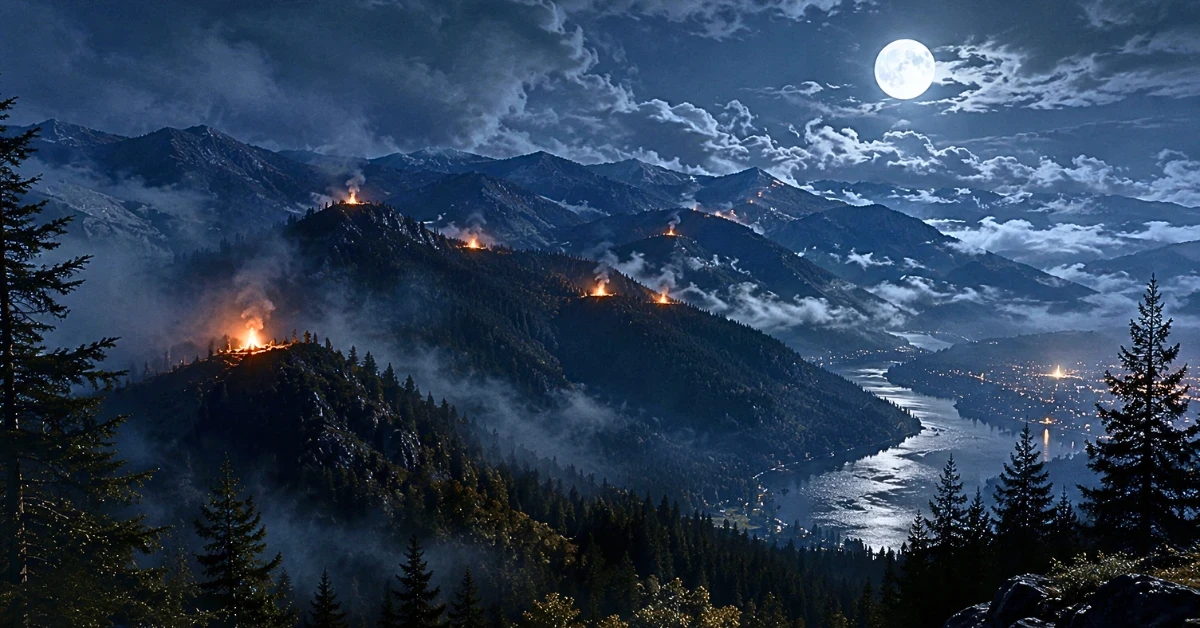
During these gatherings, organized signal fires reportedly burned high on the mountain ridges surrounding Mystery Valley for four consecutive nights, while meetings occurred deep within the remote cave systems honeycombing the rock faces below. The sheer detail of the narrative is what makes it stand out. Most folklore gets soft around the edges as the decades pass, losing its specifics and dissolving into vague campfire stories. Yet this specific legend maintained its structure through generations of storytelling. It consistently pointed to the exact same valley, the exact same caves, the exact same summer month, the same lunar phase, and the same rigid four-year timeline.
Mystery Valley and the Heart of the Legend
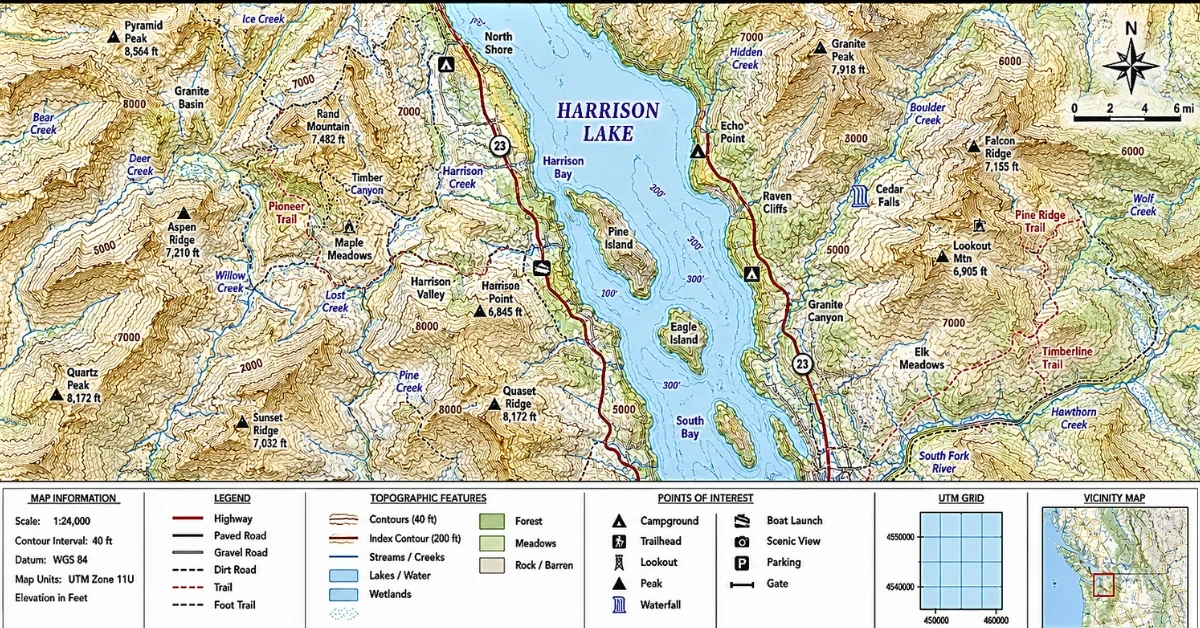
Every investigation has a center point, a physical anchor where all the lines on the map eventually cross. For this investigation, that center point appears to be Mystery Valley. Located on the western side of Harrison Lake, Mystery Valley has become one of the most talked-about and legendary locations in Sasquatch lore. Again and again, every trail and historical account seems to lead back to this exact same area. Not another mountain range, not a random valley down the road, but the exact same pocket of rugged country.
The caves of Mystery Valley are said to be the absolute location where these massive gatherings occur. According to the old stories, the Sa:sq’ets would retreat into these remote subterranean networks every four years beginning on the July full moon, while those huge signal fires burned high above on the surrounding mountain ridges for four consecutive nights. Whether those fires were physical, symbolic, ceremonial, or something else entirely remains unknown to modern science. What matters to me is that the location remains entirely consistent.
As somebody who looks for patterns for a hobby, that spatial consistency immediately stands out. Locations are often among the most stable and honest elements of any long-preserved tradition. People may change the narrative details over the decades, and interpretations may evolve to fit the modern era, but the physical places often remain locked in stone. The consistency surrounding Mystery Valley is one of the strongest patterns I have found so far in the entire investigation, and it tells me that something real happened in that valley to anchor those stories so deeply.
The Sts’ailes and Sa:sq’ets
The meeting of woods and spirit
No serious discussion or investigation into Harrison can even begin without recognizing and respecting the Sts’ailes people. The very word Sasquatch that we use today is just a clunky, Westernized mispronunciation of their traditional term Sa:sq’ets. This is a critical distinction to make because many modern researchers and internet commentators approach Sasquatch strictly as a biological question. We want to force it into a neat, scientific box. We debate whether it’s an undiscovered primate, a relic hominid, or an unclassified ape operating purely on survival instinct.
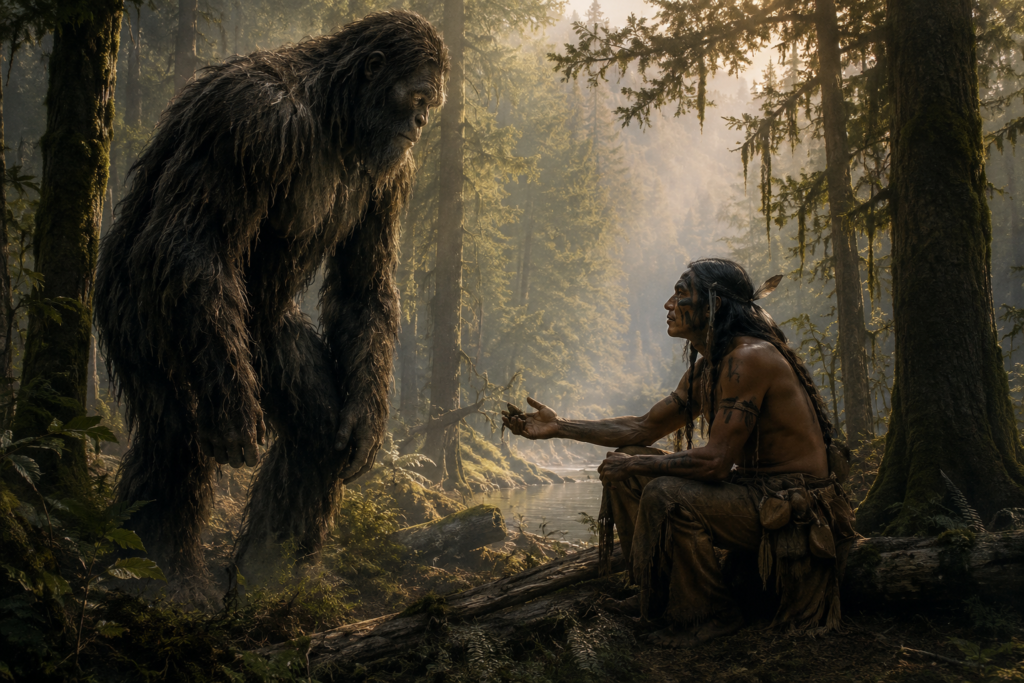
The Sts’ailes traditions approach the subject from a completely different direction. In many of their ancient teachings, Sa:sq’ets is not merely described as a wild animal wandering aimlessly through the timber. Instead, it is often portrayed as a spiritual caretaker of the land, a guardian, a watcher, and a presence connected deeply to the natural laws of the world itself. Some traditions describe Sa:sq’ets as possessing intelligent abilities that extend far beyond what most modern people would consider normal physical reality, which is where many of the older shape-shifting and vanishing stories emerge.
This is also where the conversation becomes much deeper than just looking for footprints and snapping photographs. Whether a modern researcher personally agrees with those spiritual traditions or not is completely beside the point. The point is understanding that these stories existed as an entire cultural landscape long before modern researchers arrived with cameras, plaster casts, and field notebooks. To understand the mystery, you have to look at how the people who lived alongside the phenomenon for thousands of years actually viewed it.
J.W. Burns and the Early Records
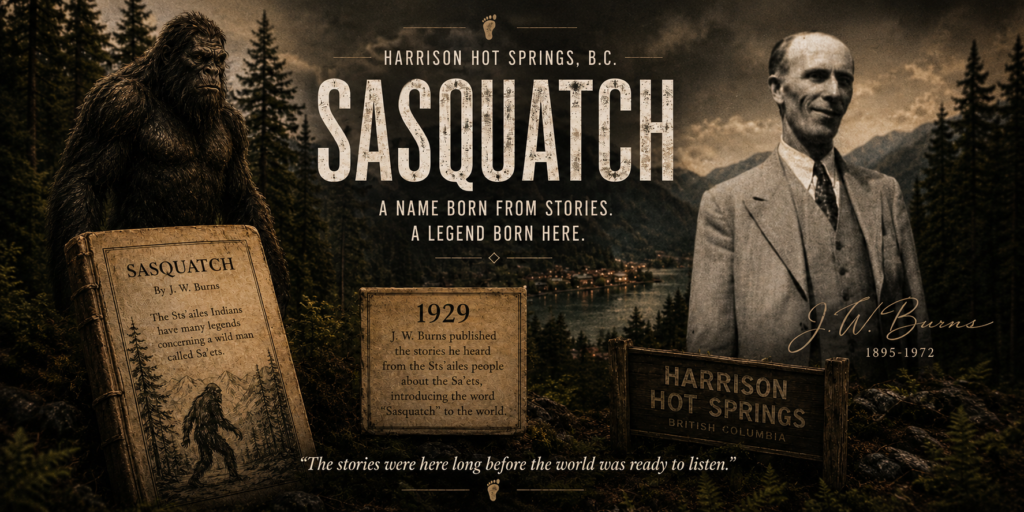
One of the most important historical names connected to the Harrison region is J.W. Burns. Burns served as the government Indian Agent for the Chehalis Reserve during the early twentieth century, and he spent decades listening to and collecting stories from local Indigenous elders when the rest of the world was completely ignoring them. He is the man credited with introducing the word Sasquatch to the mainstream public back in the 1920s and 30s. What has always fascinated me about Burns’ work is that the accounts he recorded did not describe a dumb, wild animal hiding in the brush. They described something far more complex.
The stories Burns preserved described families, structured communities, and what the elders referred to as mountain people. They spoke of hairy giants living in organized groups within caves and remote, inaccessible locations. One of the most famous accounts he brought to light involves a woman named Serephine Long, who claimed to have been taken directly to a cave near Mount Morris, where she reportedly observed an entire family of these giant beings living together under one roof.
What stood out to me when analyzing Serephine’s story wasn’t the sensationalism, but the domestic structure of the account. The story described a home, a clear family dynamic, stored food, social organization, and most importantly, a fire burning within the cave for warmth and light. Once again, we see fire appearing in an early historical account where most modern people assume it shouldn’t exist. That doesn’t prove anything on its own, but it certainly raises serious questions about the level of intelligence and culture we are actually dealing with out in the woods.

Layouts that drop historical data side by side make the patterns impossible to ignore. Looking closely at the details, Serephine Long’s original account occurred in 1871 near Mount Morris, is the 22nd encounter down the page, right in the Harrison River region. She was 17 years old when she went missing, remaining with the creatures for nearly a year before returning to her village in 1872. Decades later, she shared the exact details with J.W. Burns.
When you look closely at how this specific case has been handed down through history, you find a level of consistency that is downright startling. Here is the funny thing about how this all connects. J.W. Burns originally wrote this down and recorded it as a true historical ledger. I first found the basic outline on a very credible research site, and then I dug up an independent story about the exact same occurrence on an entirely different platform. When you look at how Burns operated, he was really just a damn good journalist. He was a long form investigator doing exactly what I am doing here, which is boots on the ground reporting of the raw facts he uncovered without the mainstream filter.
But then here is the absolute kicker that highlights just how critical this part of the topic has become. The legendary journalist John Willison Green unearthed those exact same files and wrote about them heavily in his own books, which you will see in detail in the next section where I break down his work.
The deeper rabbit hole surrounding her return went completely unedited in the traditional local archives. Mainstream articles from nearly a century ago censored the true gravity of Serephine’s experience to protect conservative public standards. The traditional records reveal that her time in the cave resulted in a hybrid pregnancy. When her health failed from the brutal physical toll of their subterranean lifestyle, the creature carried her back to the edge of the woods. She stumbled into her village in 1872 in a state of absolute exhaustion and went into immediate labor that exact night. She gave birth to a severely deformed hybrid child that tragically only survived for a few hours. Serephine survived the trauma and lived a long, quiet life on the reserve for another fifty years before breaking her silence to Burns.
Discovering this layout completely changes the weight of the historical narrative. This is not just some random campfire story invented for entertainment. This was a real, documented event that was actively discussed by the community, recorded by an official investigator, and eventually vetted by the dean of research himself. The history behind this place is phenomenal, and looking at the absolute hardships these witnesses endured makes me realize how little the modern world actually understands about the landscape. This massive historical overlap is exactly one of the core things I intend to look into when I head down to Harrison Hot Springs.
I’m not laying this out to force a definitive proof down anyone’s throat. As a researcher, my job is simply to walk you through the raw data and let the consistency do the talking. When you have three completely different eras of documentation validating the exact same unconventional details, it stops looking like a simple campfire myth. It points directly to a real, repeating lifestyle that has been quietly operating in the shadows of the Harrison River region for generations.
The core of the matter comes down to consistency. Skeptics routinely dismissed Albert Ostman as a man who fell asleep in the woods and dreamed up an elaborate fantasy. But Ostman came forward in 1957. Serephine Long’s encounter happened in 1871, and her testimony was preserved by J.W. Burns long before Ostman ever broke his silence.
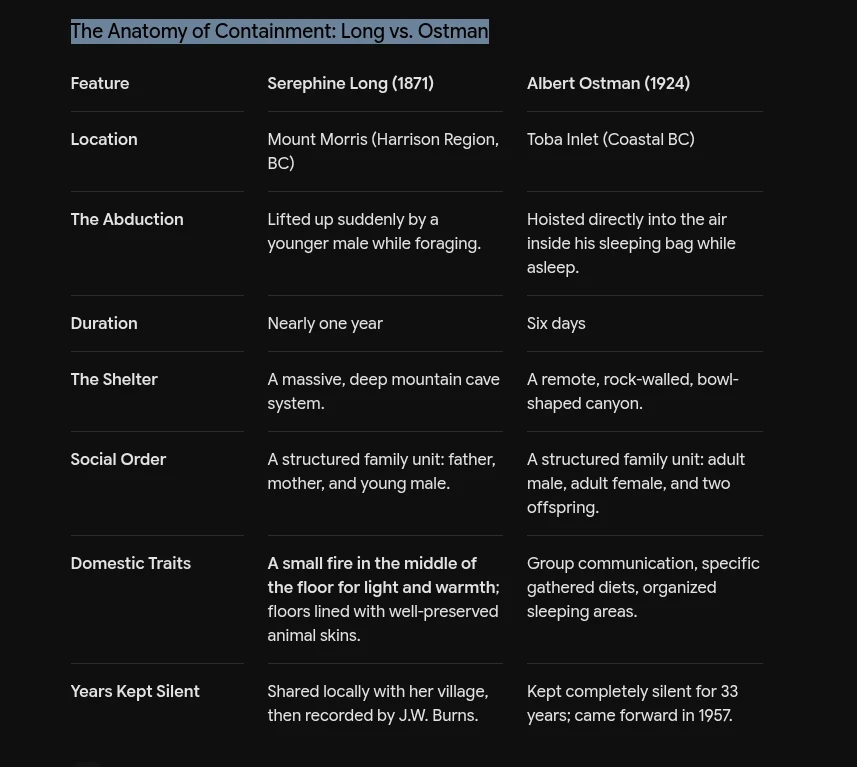
How do two completely unrelated witnesses, separated by fifty-three years and hundreds of miles of rugged wilderness, fabricate the exact same unconventional details? A standard wildlife encounter does not involve a family dynamic, skin-lined floors, or fire usage. A standard myth focuses on terror, not domestic observation. When the small, underlying details match across generations, it points away from random fabrication and directly toward a real, repeating lifestyle.
When you strip away the decades and the distances separating these witnesses, the structural mechanics of their experiences are identical. Here is a side-by-side comparison block built to show you readers exactly how the baseline features match up.
John Green and Harrison Hot Springs
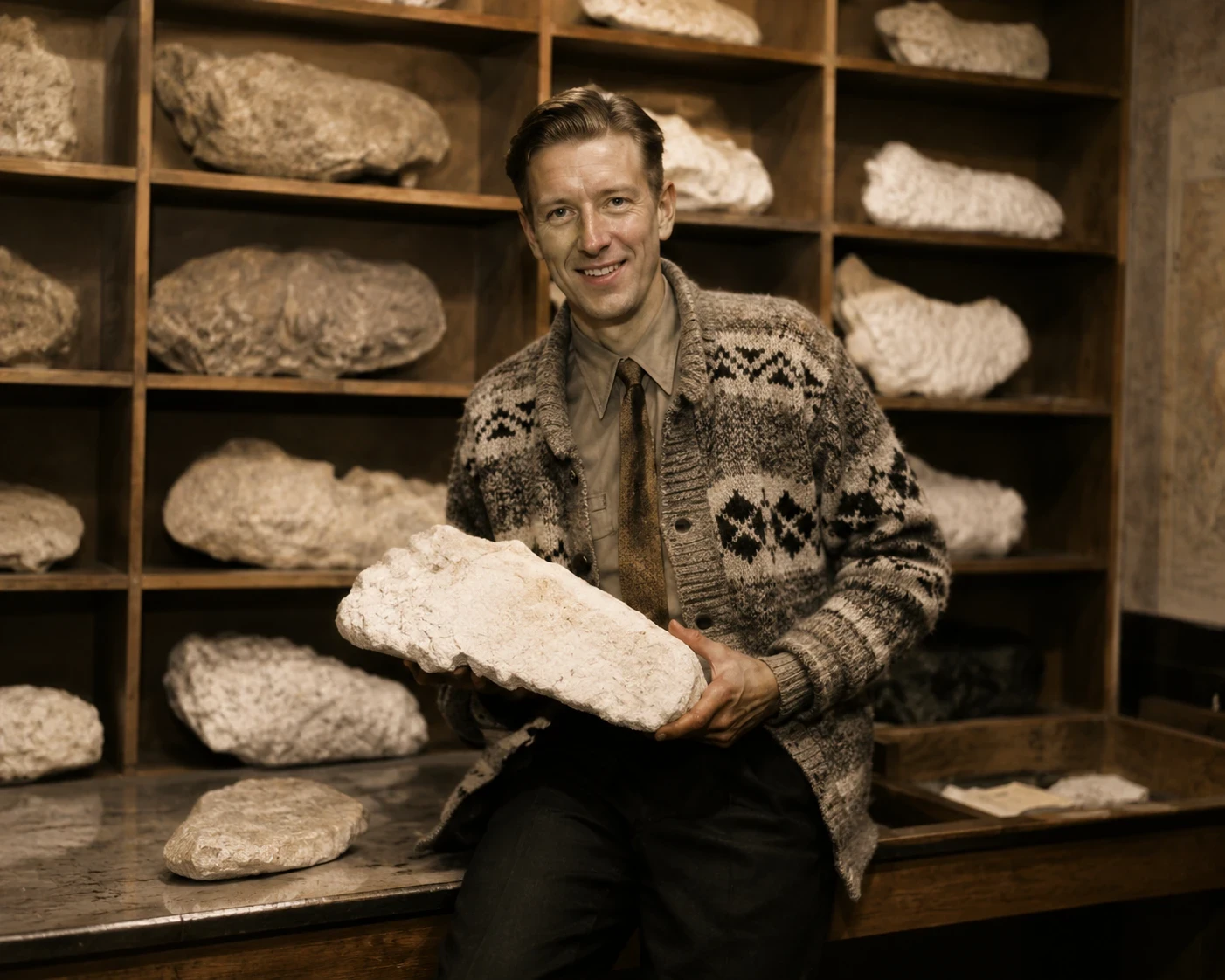
John Green analyzing track cast evidence, bringing journalistic standards to cryptozoological research.
No historical discussion of Harrison would ever be complete without talking about John Green. For many researchers, myself included, John Green remains one of the most important, foundational figures in the history of Sasquatch research. He wasn’t some armchair investigator studying the Pacific Northwest from a computer screen thousands of miles away; he lived right there in the Harrison area. He served as the local mayor, owned the regional newspaper, and spent decades meticulously collecting and investigating reports from across North America.
What makes Green particularly important to this specific investigation is his deep, personal intimacy with the landscape. He knew the rugged terrain of Harrison Lake like the back of his hand, he knew the local families, and he understood how the local stories connected to the geography. He brought a level of journalistic integrity and hard-nosed skepticism to the topic that laid the tracks for everyone following in his footsteps. The more I learn about Green’s early work, the more convinced I become that the Harrison region still contains deep, unanswered questions waiting for someone to look at them with a fresh set of eyes.
The Journalist Who Codified the Mystery
If you want to understand why the Sasquatch topic survived the scoffing of the mid-twentieth century, you have to look at John Willison Green. He wasn’t a monster hunter, and he wasn’t looking for fame. He was a professional, data-driven journalist who applied rigorous investigative standards to a subject that mainstream science refused to touch.
Born in 1925 in Vancouver, Green grew up with an analytical mind, eventually earning a bachelor’s degree from the University of British Columbia and a master’s degree in journalism from Columbia University in New York. After serving in the Royal Canadian Navy during World War II, he built a serious career in print media, working for major papers like the Toronto Globe and Mail and the Vancouver Sun. By the 1950s, he settled in the Fraser River Valley, purchasing and editing the Agassiz-Harrison Advance newspaper right in the heart of Harrison Hot Springs territory.
Green’s lifecycle changed forever in 1957. What started as local reporting on Harrison’s upcoming centennial Sasquatch search transformed into a lifelong pursuit. Over the next fifty years, Green compiled a massive database of more than three thousand sighting reports, wrote definitive books like Sasquatch: The Apes Among Us, and became globally recognized as the foundational dean of hominid research.
The Vetting of Albert Ostman
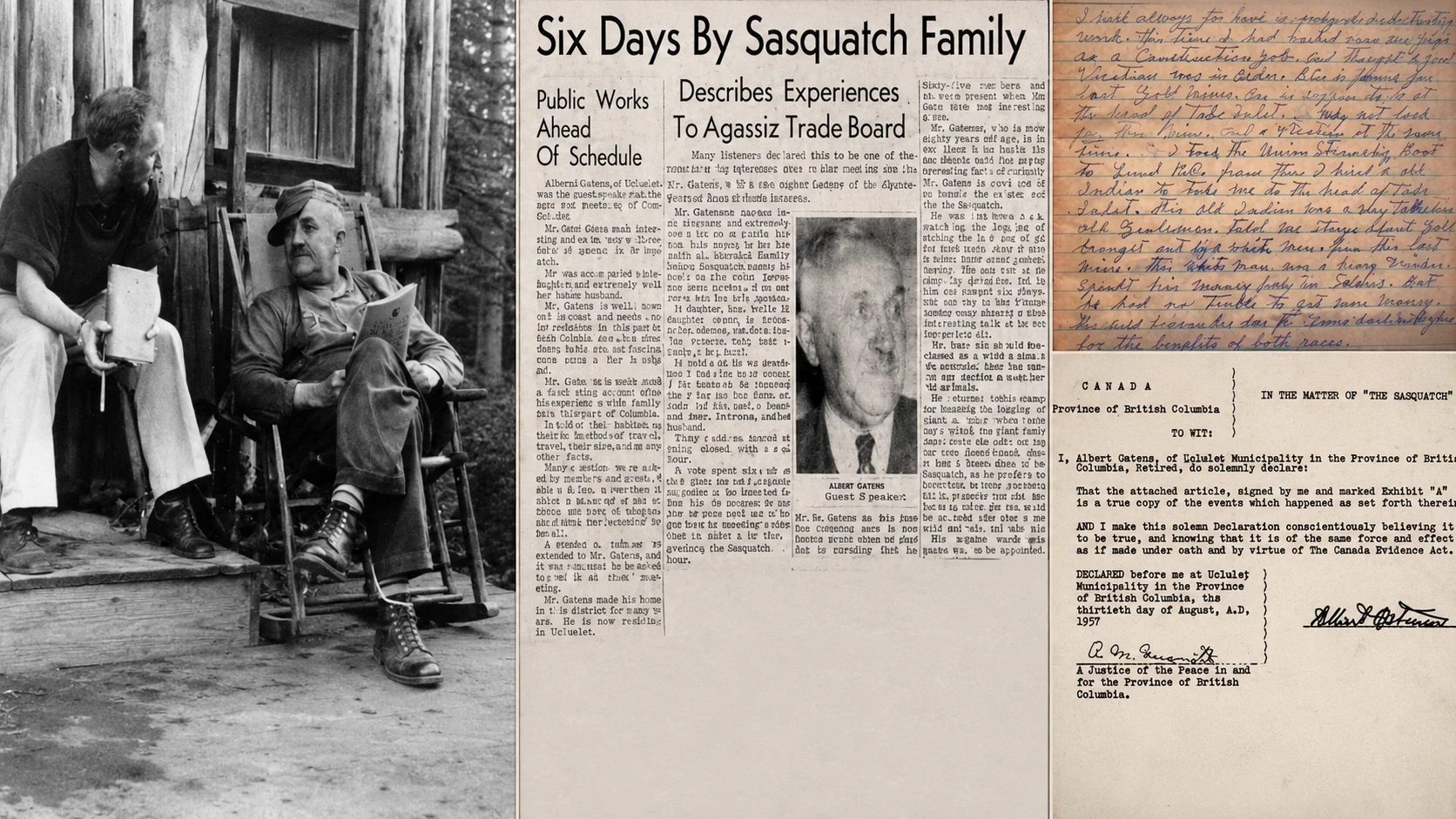
Research Credit: This collage was inspired by the Reddit discussion The Albert Ostman Story Revisited and helped bring together historical photographs, sketches, newspaper coverage, and affidavit materials associated with the Ostman case. Credit to the original creator for compiling these reference materials.
John Green’s biggest contribution to the pattern recognition argument was his direct handling of Albert Ostman. When Ostman broke his thirty-three year silence in 1957, he didn’t go to a supermarket tabloid; he went to Green’s newspaper office.
Green knew that extraordinary claims required objective vetting. He didn’t just write down Ostman’s story and print it as gospel. He used his investigative training to test the old prospector’s credibility. Green had Ostman sign a formal Statutory Declaration, legally binding his testimony under oath. To push the vetting further, Green coordinated a professional polygraph examination. Ostman passed, demonstrating that whether his story was believable to the public or not, he was telling the absolute truth as he experienced it.
What blew Green’s mind, and what most modern readers completely miss, is the cross-generational data match. Ostman was an isolated logger and prospector who spent his life in remote camps. He had no access to academic ethnological records or niche Indigenous oral histories when he was taken in 1924. Yet, the domestic structure he described the specific family dynamics, the gathered plant diet, the structured living space was identical to the 1871 encounter of Serephine Long.
If you want to look at the raw journalistic evidence yourself, the official academic record of John Green’s first hand investigation has been preserved permanently by Idaho State University. This forensic document includes Green’s own direct commentary on why he took the old prospector seriously, his notes on the box canyon family dynamic, and the exact steps he took as a newspaper editor to vet the details. Green openly admitted that an abduction story sounded wild on the surface, but he notes that Ostman was a remarkably believable fellow whose small, underlying observations perfectly matched the broader biological reality. You can read the complete university archive and look at the direct research files here:John Green: A Lifetime of Sasquatch Research.
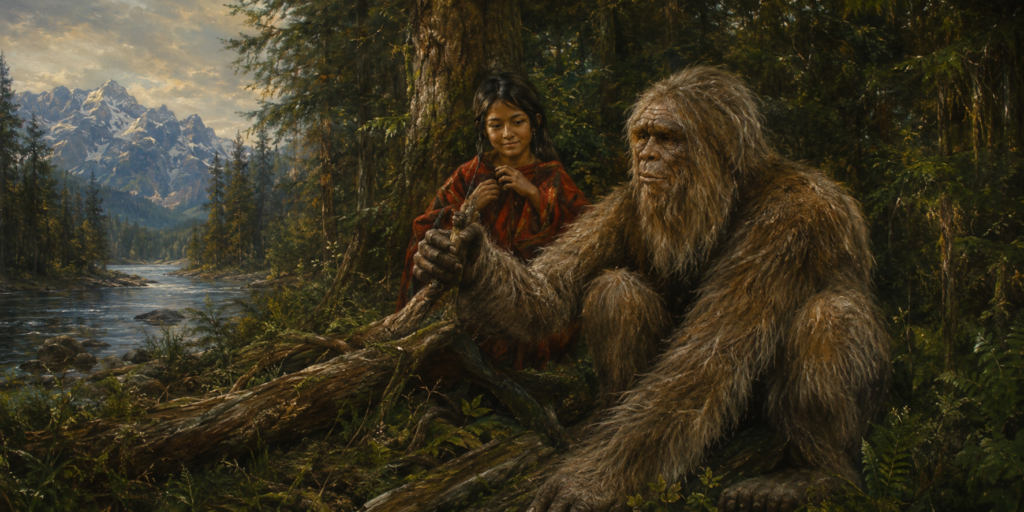
Image Credit: Based on historical artwork depicting Serephine Long’s account near Mount Morris. This image has been digitally enhanced and reimagined by Wildfoot Explores for illustrative purposes.
Think about the sheer impossibility of that connection if both accounts were fabricated. You have a seventeen-year-old Indigenous girl from the Chehalis Reserve in 1871, and a Swedish immigrant prospector near Toba Inlet in 1924. They did not know each other. They lived decades apart. Yet, both independent witnesses reported that these creatures live in cooperative family units, utilize cave or canyon containment, and maintain a domestic structure that includes the controlled use of fire for warmth. John Green realized that two unrelated people cannot hallucinate the exact same highly specific, unconventional details across half a century. It isn’t a shared myth; it is a shared observation of a real biological lifestyle.
The Shadow Geography
I’ve spent fifteen years staring through the windshield of a heavy haul truck, watching the blacktop twist through the Alberta bush and snake into the rugged backcountry of British Columbia. When you spend that much time moving thousands of tons of iron over frozen muskeg and narrow oilfield roads, you develop a different relationship with the land. You quickly learn that what you see from the highway is just a thin, fragile ribbon of human noise. Step ten yards off the shoulder of an isolated logging road in the Fraser Valley, and the forest swallows you whole. The sheer scale of the wilderness in western Canada is hard to comprehend unless you’ve stood at the bottom of a canyon where the sun only hits the dirt for two hours a day, or looked at a topographical map and realized the blank green space in front of you stretches for three hundred miles without a single paved road, power line, or cell tower.
The broken surface is only half the story, and this is where the rabbit hole goes genuinely deep. Karst landscapes are formed by the dissolution of soluble rocks like limestone, dolomite, and gypsum, creating thousands of miles of subterranean drainage systems, sinking streams, vertical shafts, and unexplored caverns. British Columbia has some of the highest concentrations of karst terrain in North America, and a vast majority of it is completely undocumented. We aren’t talking about tourist caves with concrete walkways and handrails. We’re talking about vast, dark, underground networks that stretch for miles beneath the mountains, many with entrances hidden by thick vegetation, waterfall curtains, or sheer cliff faces. If you trace the geological formations from the Harrison River Valley through the coastal ranges, you find a subterranean landscape that is largely a blank slate to modern science. If an intelligent, resourceful hominid population utilized these underground networks as their primary sanctuaries, suddenly the lack of surface evidence makes a lot more sense. They wouldn’t be living on the landscape; they would be living through it, utilizing the subsurface to move, shelter, and bypass human presence entirely.
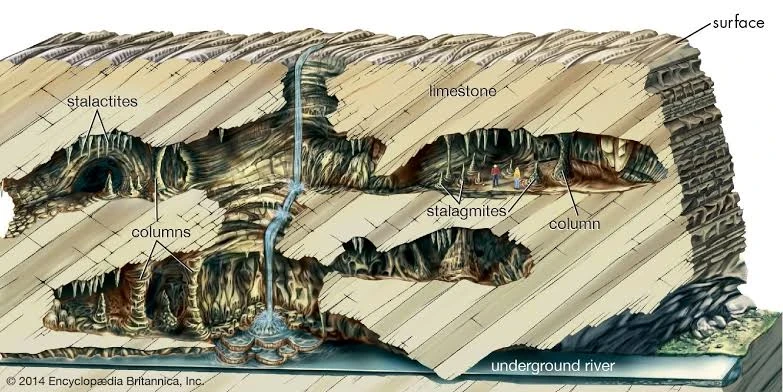
A geological look at how karst limestone cave networks form extensive subsurface corridors.. Source: Britannica
The Fire Reports
Once I started pulling on the fire thread, I began discovering that these accounts aren’t completely isolated to Harrison. Although they are admittedly rare and often ignored by mainstream researchers who want to keep the phenomenon strictly inside an animalistic box, stories involving Sasquatch and fire appear in multiple independent database reports.
Some modern witness accounts from organizations like the BFRO describe mysterious, contained fires appearing on remote, inaccessible ridges where no human hikers or campers could reasonably climb. Others describe large, bipedal creatures standing just beyond the tree line, silently watching human campfires from the pitch darkness for hours at a time. A few highly controversial reports even claim that active, burning logs were carefully lifted or carried away from remote campsites by something massive.
Modern researchers continue to heavily debate these specific fire reports, and many of them remain completely unverified and controversial within the community. But the fact remains that they exist. They sit quietly in the margins of the databases, and that alone is fascinating to me because it directly challenges the absolute baseline assumption held by skeptics and researchers alike. It challenges the assumption that fire and Sasquatch never intersect.
A Global Pattern Emerges
As anyone who follows my work with Wildfoot Explores already knows, I have a habit of following patterns wherever they lead, even if they take me across oceans. So I began looking far beyond the borders of British Columbia to see if this connection between wilderness beings and fire showed up anywhere else. What I found completely surprised me and shattered my localized view of the phenomenon.
In the rugged bush of Australia, ancient Aboriginal traditions involving the Yowie and the mysterious Min Min Lights contain recurring, centuries-old themes involving massive, hairy wilderness beings, unexplained lights on high ridges, and strong connections to moonlit environments. The Great Dividing Range and the Blue Mountains of New South Wales are notorious for these accounts. Early European settlers and Indigenous trackers reported seeing localized, contained fires burning on inaccessible cliff faces deep within Yowie territory, completely isolated from human activity.
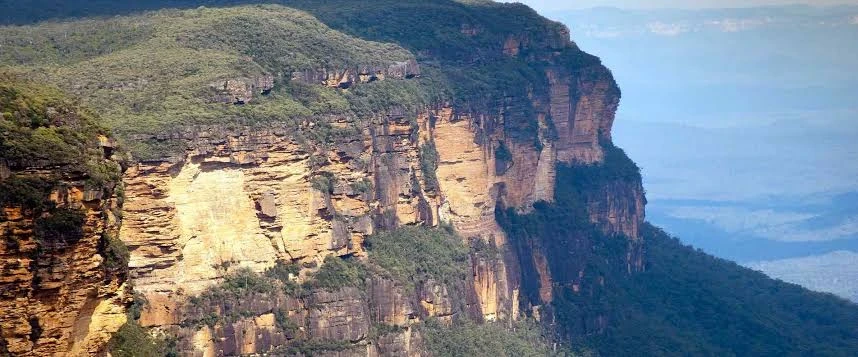
The rugged, cliff-cut terrain of Australia’s Blue Mountains where similar ridge fire anomalies reside.. Source: Blue Mountains Tours
Across the ocean in China, historical regional archives surrounding the Yeren place the creature in the exact same environmental template: rugged mountain terrain, deep cave systems, and remote ridges overlooking human activity. While reviewing historical archives from the Hubei province, specifically the Shennongjia Nature Reserve, I encountered recurring reports of ghost lanterns or wildman fires appearing on high, cloud-covered ridges during the mid-summer months. The locals believed these fires marked specific times when the Yeren would descend from the highest peaks to gather in the valleys before retreating back into the absolute wilderness.
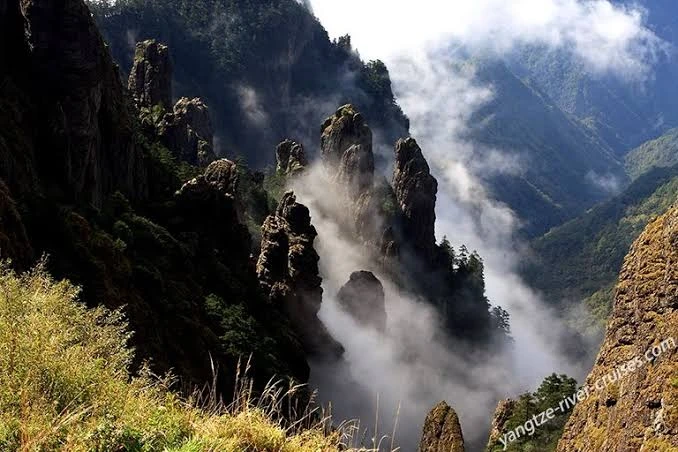
The remote, fog-covered peaks of the Shennongjia Reserve in central China.. Source: Yangtze River Cruises
When you stand back and look at these different cultures, different continents, and different explanations, the geographical isolation is absolute. There is no way for these traditions to have cross-contaminated each other centuries ago. Yet the exact same structural themes continue to appear: mountain ridges, remote cave networks, the intentional use of fire or unexplained lights, specific moon cycles, and mysterious, intelligent beings connected deeply to the land itself. Does that prove they are all describing the exact same physical creature? Absolutely not. But it creates an undeniable, cross-cultural pattern that is too consistent to dismiss as random coincidence.
The Four-Year Mystery
Of everything I have uncovered during this investigation, one massive question continues to stand completely above all others, and it’s the one that keeps me awake during long night hauls. Why every four years? Not every single summer, not every full moon, and not even every consecutive year. Four years.
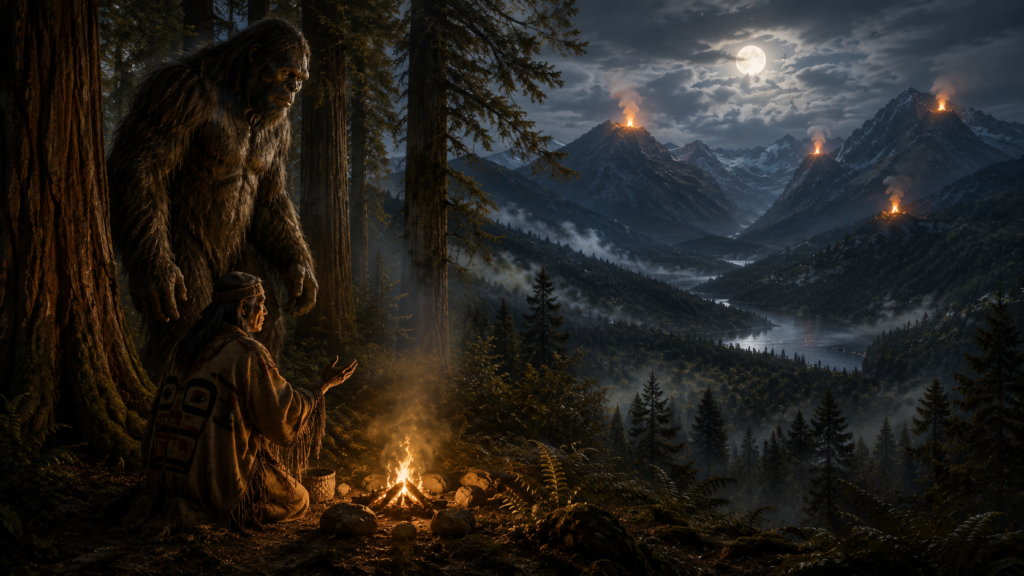
Guardians of the misty valley
That specific detail bothers me in the best possible way. In the study of oral histories, highly specific timing rarely survives for generations without a very real, tangible reason keeping it alive. The more I researched the old oral traditions of the valley, the more I realized an important historical fact: the timeline didn’t just suddenly begin in 1940. That particular year was simply the last commonly recorded observation year where outside witnesses reported seeing the signal fires burning on the ridges surrounding Mystery Valley before the tradition seemingly went quiet.
The story itself is much, much older than 1940, which means the people of the valley were tracking this exact four-year cycle long before anyone ever wrote it down on a piece of paper or printed it in a book. Maybe the cycle was ceremonial, maybe it was observational, or maybe it was tied to a natural migration pattern we no longer understand because we’ve cut ourselves off from the land. I don’t pretend to have the answer yet, but I intend to find out.
August 2014 near Mount St. Helens. Two backcountry researchers deliberately positioned themselves in a known hotspot within Lewis County, Washington, sitting in total, pitch-black darkness with zero artificial illumination. They used a highly structured communication system: they would play acoustic ditties on their harmonicas to ease the environment, but if actual contact was made, they agreed to play a specific song, “Jingle Bells,” to alert a remote thermal imaging post up the trail.
At 1:00 AM, after hearing classic wood knocks nearby, the witnesses observed a floating, basketball-sized red orb with a slight orange tinge moving near the forest floor. Just like the 1871 and 1924 accounts, this wasn’t a random, mindless flash of light. It was controlled, targeted utility.
The light cast a perfect, fan-shaped illumination pattern on the dirt, throwing the surrounding ferns into sharp silhouette. As the orb bobbed up and down in a distinct “sniffing” motion, it illuminated a massive, fleshy appendage right next to it. The witnesses watched in awe as a giant index finger, complete with visible knuckles and a fingernail, slowly moved through the light beam toward the forest floor before the source gradually dimmed and went out.
The Global Loop: Pulling Back the Curtain
If you look past the highway noise, the modern tourist traps, and the sterile explanations mainstream science tries to feed us, you realize we are looking at a massive, interconnected puzzle. I added this specific dimension to the investigation because it cuts through the local noise and highlights a global reality. When you track the raw data instead of buying into the mainstream hype, you start to see how everything connects.
We have been tracking a specific four year cycle, and it is a detail that changes everything. The history books tell us that the legendary gathering fires on the peaks of Harrison Hot Springs simply vanished after 1940. They want you to believe the story ended right there, that the mountain people simply died out or moved on. But they did not stop. They just shifted locations. They moved deeper into the backcountry, continuing the exact same ancient behavior elsewhere on the exact same chronological wavelength.
“Look at the math. If you project that original 1940 baseline straight into our current year of 2026, the grid locks in perfectly. 1940 leads to 1960, 1980, 2000, and 2020. Every single one of those years lands dead on the four-year mark, perfectly framing that massive 2012 incident on the Olympic Peninsula where researchers watched amber lights move across an impassable cliff face right before their camp was aggressively flanked by multiple chattering voices. Keep counting by fours and you hit 2016, 2020, and 2024
Sitting here in 2026, you and I are living exactly at the halfway mark of the current cycle. We are in the quiet wake of whatever happened out there in 2024, and the clock is already ticking down toward the next alignment in 2028.
It gets wilder when you pull in the lunar calendar. The old Chehalis and Sts’ailes records preserved by J.W. Burns did not just say every four years. They specified that the mountain people began their gatherings precisely on the full moon in July. This was the exact same municipal landscape analyzed decades later by John Green, a data driven newspaper editor who served as the actual mayor of Harrison Hot Springs during the late 1950s. This was a man of immense community standing and absolute integrity whose leadership and beach building projects are fully recorded in historical features by Montecristo Magazine and preserved permanently within his official newspaper obituary. He looked at these exact chronological timelines and realized the data could not be ignored.
Now, look at the global picture. Is it just a coincidence that across the planet, in the deep outback of Boulia, Australia, the famous Min Min lights historically spike in intensity during the exact month of July, clustering around the full moon on a documented structural rhythm? Even the analytical data compiled in the University of Queensland Scientific Archive confirms that these bizarre, self-willed glowing masses are physically real, defying standard atmospheric rules in the exact same desolate corridors where ancient encounters are tracked.
If you map this out as a pure data researcher, you start to see that the world is shouting the same truth. Every single culture has a famous ghost light, and every single one of those locations is haunted by the exact same history of a bipedal wildman.
In England, you have theLongdendale Ridge Recordsoperating on the first full moon of Spring, right in the ancient territory of the hair covered Woodwose. In the desolate marshes of India, you have theChir Batti Archivedetailing fireballs rising during the monsoons, right where the local tribes track the silent, long haired Van Manush. In Michigan, the Paulding Light Documenthovers over a swampy timber hotspot known for heavy bipedal stalking. In the cave pitted Ozark landscape, the Hornet Spook Light Historyswings through the exact same hollows where landowners documented the hairy, bipedal Momo.
Skeptics will tell you that humans across oceans and centuries just happened to invent the exact same double myth and glue it to the exact same isolated valleys by pure chance. They want you to believe that an English farmer in the 1800s, an Indian herder in the wetlands, an Aboriginal tracker in the bush, and a heavy haul trucker in the Canadian north are all sharing the exact same double hallucination.
But a coincidence happens once. When it repeats globally on a fixed structural loop, it becomes an objective mechanic of a real, repeating lifestyle.
They are not separate mysteries. From Serephine Long’s cave fire in 1871, to Albert Ostman’s canyon in 1924, to the 2014 Mount St. Helens report where a floating orb illuminated a massive, three knuckled finger tracing the dirt, it is all the same coin. We are looking at an intelligent, non human population that has completely mastered the shadow geography. They are counting the years, moving through the subsurface, and keeping the fire burning far beyond the reach of our headlights.
Instead of casting out a blind prediction and waiting to see what happens, I am taking a direct, active approach to this timeline. The next major quadrennial milestone hits the grid dead on during the summer of 2028, specifically centering on the nights surrounding the full moon on July 6, 2028. I am already marking that exact date on my calendar for a dedicated backcountry expedition. When I am down in Harrison Hot Springs here in about a week, I am going to use that time on the ground to scale the local topography, study the limestone formations, and actively scope out the territory. We are going to map out the access corridors now so we are fully prepared to track the data when the cycle resets.
People Also Ask
Who was J.W. Burns and what did he do for Sasquatch history?
John William Burns was a Canadian government Indian Agent assigned to the Chehalis Reserve in the Fraser Valley during the early twentieth century. He is widely credited with introducing the word “Sasquatch” to the mainstream public in the 1920s and 1930s through his articles in publications like The Maclean’s Magazine. Burns spent decades listening to, documenting, and taking seriously the oral histories of local Indigenous elders when mainstream science completely ignored them. His records are critical because they described the Sasquatch not as a simple, wild animal, but as a complex population of intelligent “mountain people” living in organized, cooperative family units.
Is the Albert Ostman kidnapping story real?
The 1924 account of Swedish-born Canadian prospector Albert Ostman remains one of the most thoroughly vetted encounters in cryptozoological history. Ostman claimed he was abducted while sleeping in his sleeping bag near Toba Inlet, British Columbia, and carried into a remote canyon where he was held captive for six days by a family of four giant, hairy humanoids. To test his credibility, pioneering journalist John Green had Ostman sign a legally binding Statutory Declaration under oath and arrange for a professional polygraph test. Ostman passed the lie detector examination completely, and researchers consider his highly detailed observations of the creatures’ diets, communication, and domestic habits to be a foundational baseline for the topic.
Who is John Green in Sasquatch research?
John Willison Green is universally recognized as one of the foundational “Four Fathers” of modern Sasquatch research. He was a professional, Columbia University-trained journalist and newspaper editor who served as the mayor of Agassiz, British Columbia, right next to Harrison Hot Springs. Green brought rigorous investigative reporting standards, data-driven analysis, and strict vetting to the subject, eventually compiling a massive database of over three thousand documented sighting reports. His seminal 1978 book, Sasquatch: The Apes Among Us, remains the definitive text on historical hominid evidence in North America.
Where is Harrison Hot Springs and why is it famous for Bigfoot?
Harrison Hot Springs is a village located at the southern end of Harrison Lake in the Fraser Valley of British Columbia, Canada. The region is internationally famous as a historical hotbed for Sasquatch activity due to the immense density of sighting reports, trackway discoveries, and deep-rooted Indigenous oral traditions stemming from the nearby Chehalis area. The geography surrounding Harrison features incredibly rugged mountains and vast, undocumented limestone karst topography, which many researchers theorize provides an ideal subterranean sanctuary network for an elusive, intelligent hominid population to live entirely detached from human civilization.
My Harrison Mission
This month, We are loading up the truck and heading straight out to Harrison Hot Springs for Sasquatch Days. Quite a few years ago, I was traveling out to Tofino, BC. I was right there in the area, but I never got the chance to detour back up to it. I always knew about it, but it is just one of those places.
When people talk about this topic online today, they are usually focused on the big, hyped up locations that dominate social media. They do not really notice a quiet little lakeside town like this. But if you look past the noise and study the history, this is the blueprint. This is the absolute original. The word Sasquatch itself was actually coined right here in 1929, adapted from the local Sts’ailes First Nation word Sasq’ets. Long before the rest of the world ever heard the name, this valley was the epicenter of the entire lore. That is what makes this place so interesting.
I am heading out there this year just to explore it. I want to walk the streets, check out the local stores, and take in the festival firsthand. I am going to soak in the town, the vibe, and the deep energy that completely surrounds that area. I want to walk the trails, head out into Sasquatch Provincial Park, look into the old historical reports, and document exactly what I see along the way. Most importantly, I want to respect the land and look at this place through the eyes of the people who live here. My goal is to talk to the locals, hear the history, and hopefully get the chance to sit down for a coffee and a real conversation with one of the Indigenous elders to listen to the stories they are willing to share.
Who knows, maybe I will get lucky enough to grab a print while I am out in the bush. I will have my plaster with me, so we will just have to see what we stumble across.
If you happen to be in the area and want to connect, I would genuinely love for you to sit down and have a coffee with me. While I am on the ground in Harrison, I will also be giving away some Wildfoot T-shirts to folks who are willing to share their experiences. This research has never been about winning internet arguments or proving people wrong. It is about understanding people, understanding places, and reading the language of the land.
Wildfoot Disclosure and Invitation
As an Amazon Associate I earn from qualifying purchases.
Some links in the Wildfoot Book Library are Amazon affiliate links, which may earn me a small commission at no extra cost to you.
The library includes the books I’ve written and other resources tied to Bigfoot, survival, hidden truths, and the paranormal. Everything here is meant to support your curiosity and exploration.
I only share products and books I personally believe in or created myself. You’ll also find items connected to my other platforms, including Paranormal Curiosities Realm.
Thanks for supporting independent research and storytelling.
Shawn Thomas
Amazon Author & Creator
Founder of Wildfoot Explores and Wildfoot Explores Apparel shop


What a fascinating and unusual read. I really liked how the article connects ghost lights, Sasquatch reports, Indigenous traditions, and old witness accounts into one larger pattern instead of treating every story as separate. The Harrison Hot Springs connection was especially interesting, because it gives the topic a real sense of place and history. Whether someone is skeptical or open-minded, the repeating details about fire, caves, and hidden communities definitely make you want to keep reading.
Thank you, Hanna. I really appreciate that.
One of the things that fascinated me while researching this topic was how often the same themes kept appearing, even when the stories came from completely different sources and time periods. The ghost lights, the cave accounts, the Indigenous traditions, and the witness reports all seem to orbit around the same wilderness spaces, which raises some interesting questions.
Whether someone views these stories as folklore, history, unexplained phenomena, or something else entirely, I think there is value in looking at the patterns rather than dismissing each account in isolation. Harrison Hot Springs turned out to be far more than a simple Sasquatch location. The deeper I dug, the more layers of history, culture, and mystery seemed to emerge.
Thanks for taking the time to read it and share your thoughts. I’m glad you enjoyed the journey down the rabbit hole with me.